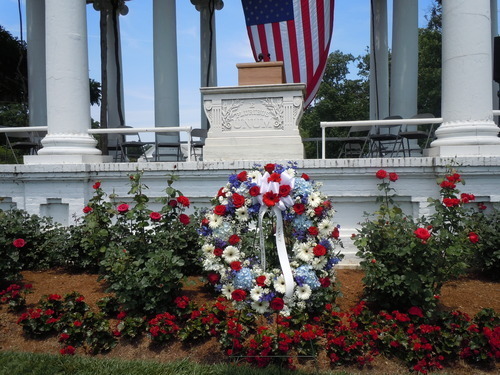
On Wednesday, June 5th, the life and service of Medgar Evers was commemorated at his burial place in Arlington National Cemetery, just across the Potomac River from Washington, DC. Evers was a WWII veteran and earned the right to be buried in this most hallowed of sites through his service to his country in Europe during that war. Some might argue, however, that his more substantive service was in his home state of Mississippi during the nearly nine years that he served as the first Mississippi field secretary for the NAACP. It was in that role that he faced the most serious threats to his life, while working to equalize the playing field for all of America’s citizens.
A Day of Commemoration at Arlington National Cemetery
No Comments
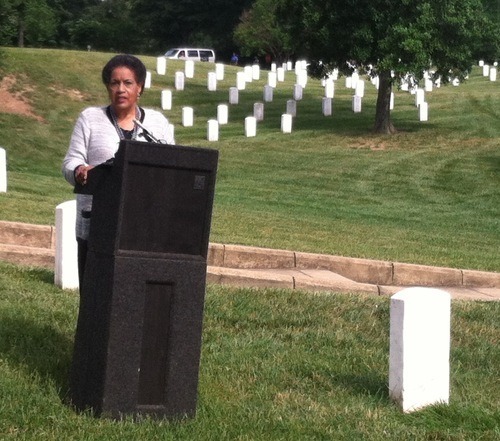
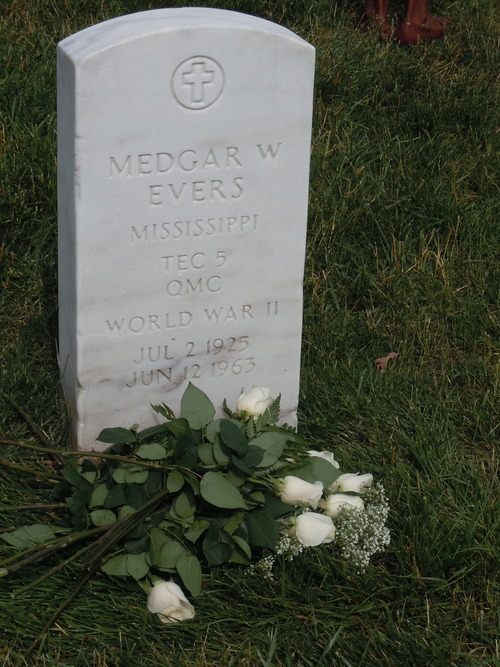
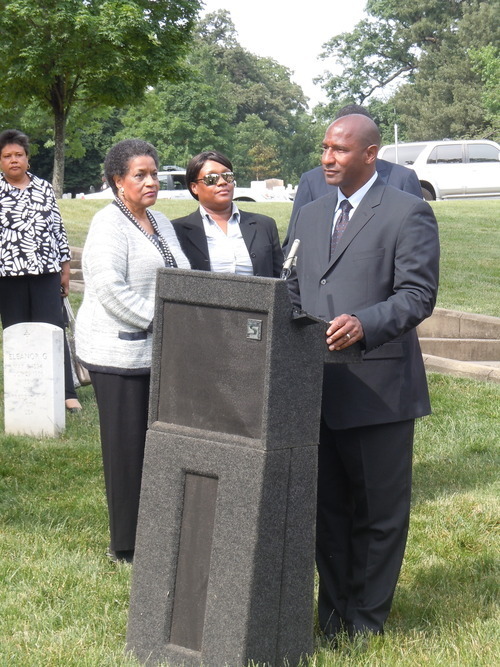
Joan Trumpauer and I started the day by visiting Medgar’s grave, a site we have visited many times, both together and separately, over the years. It is an easy walk through the Cemetery’s main gate and off to the right up Schley Drive to the first concrete sidewalk and down about a dozen stairs. There, off to the right, is the grave, which on this day had been cleared of any memorial tributes because the Evers family had prepared to have a quiet graveside commemoration before the more public ceremonies later in the day.
The family arrived promptly at 9:30 a.m. and paid their respects through commentary and prayer. Myrlie Evers spoke movingly and quite personally about how the children had to witness their father’s slaying 50 years ago. How they cried over and over, “Daddy, get up! Daddy, Daddy! Get up!” as he strugged to crawl his way to the front stoop. She recalled how Van, only three years old at the time, grew up not knowing or remembering his father and how, twenty-five years later, insisted on being present when Medgar’s body was exhumed in anticipation of the third and final trial of his killer, Byron de la Beckwith.
Upon seeing his father’s remains, which were miraculously preserved, Van told his mother, “Now I know where I come from.”
Myrlie also mentioned how she had wanted Medgar buried in Mississippi, close to the family, so that they could visit from time to time. It was the NAACP officials who convinced her that he deserved a hero’s burial at Arlington. She said how very glad she was that she listened to them. “Listen to the birds this morning,” she said. “Feel this serenity of this place.” Myrlie looked straight at Joan and me as she expressed her thanks for members of the “Mississippi contingent” for being there to mourn his loss with the family.
Myrlie introduced the various family and extended family members. She mentioned that their eldest son, Darryl, had died some years earlier. (He died of colon cancer in 2001, Darryl’s son Keenan would tell me later.) Their other two children, Reena and Van were both present, as were an assortment of cousins and grandchildren.
Reena spoke next, thanking . “He was our daddy, our love, our everything,” she recalled. “He would often come home and tell us what he was working on while he was out and about,” she said. She thanked him for helping instill in her the values of integrity and personal responsibility. Reena now serves as the CEO of the Medgar and Myrlie Evers Institute in Jackson, Mississippi. The institute seeks to “develop new generations of socially and politically activated people by transferring knowledge, sharing wisdom, and nurturing civic engagement.”
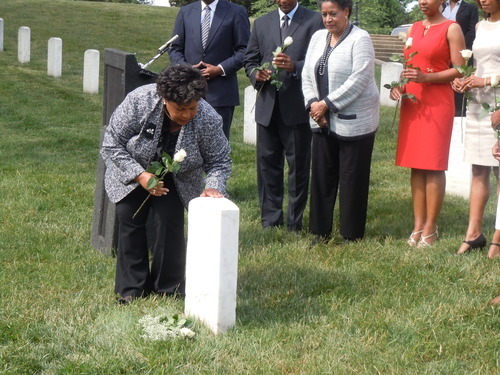
After a brief prayer, Medgar’s son Van spoke movingly, first to his slain father (“I love you, Dad.”) and then about his mother’s burden of “having to be both mother and father to us.” He thanked her for all she has done for the family and to keep Medgar’s story alive. “There is no better mother in the world,” he said.
We then made our way up the hill, past the Lee Mansion (now called “Arlington House”) and over to the Old Ampitheater, where a slew of dignitaries and additional friends and families (and a good array of tourists) had gathered. Here is the “short list” of those who gathered to pay their respects and honor this giant of the civil rights movement:
Former President Bill Clinton
Attorney General Eric Holder
Secretary of the Navy and former Mississippi Governor Ray Mabus
Current Governor of Mississippi Phil Bryant
U.S. Senator from Mississippi Roger Wicker
U.S. Congressman from Mississippi Bennie Thompson
NAACP President & CEO Benjamin Todd Jealous
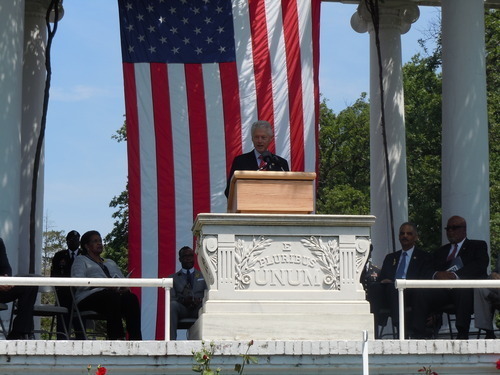
Each spoke from their own perspective about what Medgar’s life and work meant not only to Mississippi, but to the country and the world.
Finally, after an hour and a half of tributes, Myrlie spoke. This time she recounted attending a recent gallery opening in honor of Medgar’s life. There she came upon an artifact that stopped her in her tracks. The actual rifle that took Medgar’s life was on display. She looked at the trigger from which the bullet that felled her husband was launched and saw the entire tragedy played out again in her mind. But then she imagined the fire from the shot, an explosion of light and smoke, and came to believe that this represented the FREEDOM that eventually came to her home state and to the entire country as a result of her husband’s sacrifice. The bullet may have stopped a man, but it did not stop the Movement.
Then the U.S. Army Band played “Taps” and the crowd was sent off with a benediction from the president of the National Baptist Convention.
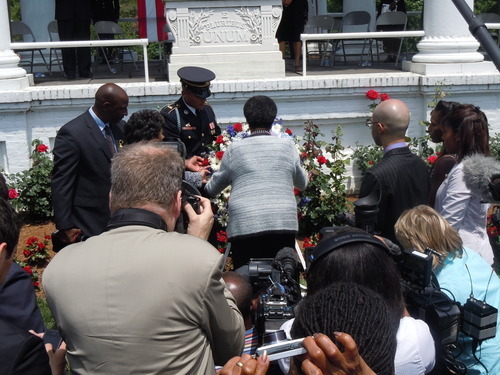
A ceremonial wreath was placed by the family on the site and then we said our goodbyes.
Rest in Peace, Medgar Wiley Evers, American Martyr and Hero.