
Soupkitchen
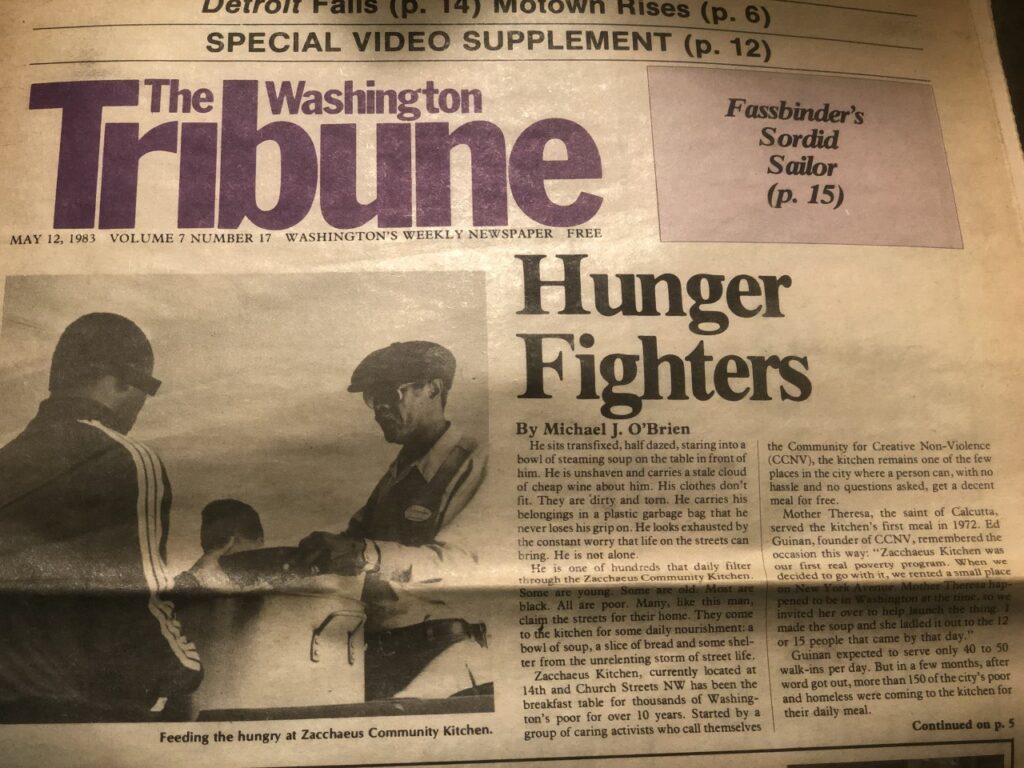
It was my friend from college days, Robert Hoderny, who
invited me down to the Zacchaeus Soup Kitchen when we both ended up in the
mid-to-late 1970s in the Washington, DC area. Robert, already a Vietnam
Veteran, joined the seminary at about the time I was planning to exit, but we kept
in touch. He quickly grew disenchanted with the Church bureaucracy and left for
more progressive pastures and ended up in DC with the Community for Creative Non-Violence
(CCNV). When I returned from my sojourn to the Midwest, mostly a 2-year stint
in Midland, Michigan (recently in the news due to a horrendous dam collapse and
horrible flooding in the downtown area), I found Robert staying at some
Augustinian guest house near Catholic University, participating in CCNV
planning meetings, teaching religion and a new course in nonviolence, poverty and ethics at Carroll
High School, and serving up soup at the soup kitchen. He invited me down one weekend
and I became a somewhat irregular volunteer for the next five years.
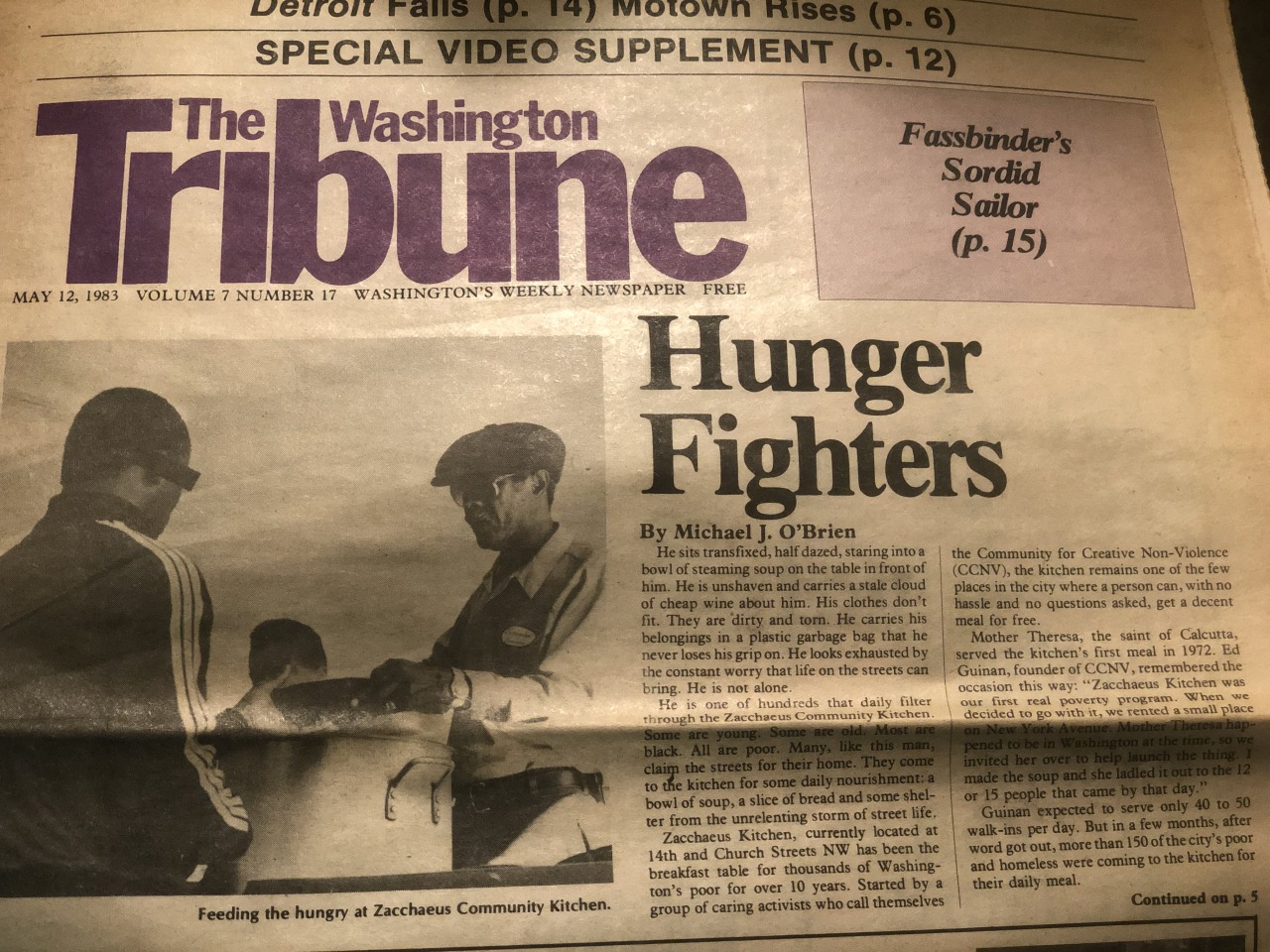
When I was asked to write a short feature article in my
American University journalism class, again taught by my beloved Professor
Tinkelman (honestly, he was NOT the only professor on staff there!), my mind
turned to my experiences at the soup kitchen and figured it might make an
interesting piece. I was right. Not only did Tinkelman love it—he read it aloud
to the entire class to my utter public embarrassment and private delight—but he
also suggested I try and publish it. Ten months later, this, my first published
piece, would appear on the cover of The Washington Tribune, DC’s-then most
popular local weekly newspaper. (Today, The City Paper, is its
successor.)
As a bonus feature to my five-part series on Dorothy Day,
here is that piece, as originally written, in its entirety….
* * * * * * * * * * * * * * * * * * * * * * * * * * * * * * * * * * * * * * * * * * *
Michael J. O’Brien Soupkitchen 7/21/82
He sits as if transfixed, half dazed, staring down at the
bowl of steaming soup on the table in front of him. He is black, unshaven, with
the smell of cheap wine on his breath. His clothes don’t fit. They are dirty
and torn. He carries his belongings in the plastic trash bag that is always at
his side. He looks tired, no, exhausted, by the constant worry that life on the
streets can bring. He is not alone.
He is one of the hundreds that daily filter through the
Zacchaeus Community Kitchen. Some are young. Some are old. Most are black. All
are poor. Many, like this man, claim the streets for their home. They come to
the kitchen for some daily nourishment: a bowl of soup, a slice of bread, and
some shelter from the storm of street life.
Zacchaeus Kitchen, located inconspicuously in the 600 block
of L Street, NW, has been the breakfast table for thousands of Washington, DC’s
poor for almost 10 years. Started by a group of caring activists who call
themselves the Community for Creative Non-Violence (CCNV), the kitchen remains
one of the few places in the city where a person can, with no hassle, with no
questions asked, get a decent meal for free.

Mother Theresa, the saint of Calcutta, served the kitchen’s
first bowl of soup in October of 1972. CCNV founder Ed Guinan remembers the
occasion this way:
“Zacchaeus Kitchen was our first real poverty program. When
we decided to go with it, we rented a small place on New York Avenue. Mother
Theresa happened to be in Washington at the time, so we invited her over to
help launch the thing. I made the soup and she ladled it out to the twelve or
fifteen people who came by that day.”
Guinan expected to serve only 40 to 50 walk-ins per day. But
in a few months, after word got out, more than 150 of the city’s poor and
homeless were coming to the kitchen for their daily meal. The New York Avenue
space proved inadequate for the crowd, so the Community found another space—its
present L Street location—to set up kitchen headquarters. Now, Guinan says,
more than 300 come to the kitchen every single day.
The Community takes responsibility for seeing that there is
enough food as well as enough people to cook and serve each day. They accept no
government subsidy.
Much of the food is donated. Over the past 10 years, CCNV
has established a network of generous Church groups and wholesale food outlets
that supply canned goods and surplus produce. Ottenberg’s bakery has given its surplus
bread to the kitchen since the program began.
Volunteer workers come from all over: church groups, Catholic
high school students, committed teachers, government workers, and other who
somehow heard about the kitchen’s work and decided to get involved. CCNV
members fill in during the work week when volunteers are scarce.
The kitchen also gets help from the District’s court system.
Offenders with minor violations are sentenced from 10 to 300 hours of service at
the kitchen, depending on the nature of their misdemeanor. “We couldn’t do it
without them,” one volunteer said. “Sometimes they’re the ones who keep this
place going.”
A typical day at the kitchen beings when workers start to
trickle in at about 6:30 a.m. Usually, someone has already put the water on to
boil the night before, so the first step is to add the beans to the steaming
cauldrons, since beans take a long time to cook. Workers then slice onions,
potatoes, carrots, celery, tomatoes, and whatever else can be found to make the
soup interesting and palatable.
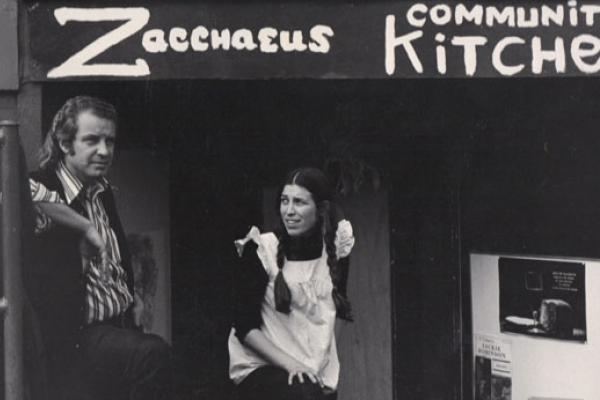
Former priest and then-poverty pioneer Ed Guinan (with wife Kathleen) at the first iteration of Zacchaeus Community Kitchen in Washington, DC, in the 1970s.
Rarely is there any meat for the soup, but when there is, it
usually must be picked from the bones of hams, turkeys, or chickens that have
already been served to more privileged groups at restaurants and posh dinner
parties throughout the city. This is the leftover kitchen: the place that
serves food that nobody really wants to people whom almost everyone would
prefer to forget.
Anarchy reigns once the workers get geared up. One person is
designated chief cook, but others give their advice—asked for or not.
“The soup
looks kind of thin to me. What do you think?
“Maybe we
can put in some noodles to thicken it up.”
“How
about some of this seasoning stuff?”
“It needs
more onions, lots of onions!”
Similar deliberations continue until about 9:15 a.m. when,
ready or not, the doors open to the hungry masses awaiting their first, perhaps
their only, meal of the day.
The ragged crowd shuffles through the downstairs cooking
area, up the steps to the serving room. The room can comfortably accommodate 50
to 60 people. It is always crowded. On nice days the tables and benches are set
outside on the sidewalk, adding a café flair to an otherwise dank and dismal
atmosphere.
The serving room is usually serene enough before the
onslaught. Trays of bread sit neatly on each table along with pitchers of hot
tea (in the winter) or Kool-Aid (in the summer). Once the crowd enters,
however, the place turns into a bombshell of congestion and confusion.
The hungry are asked to take a seat while volunteers serve
them. One worker hurriedly ladles out the soup into oversized bowls as others
rush to bring each bowl, along with an empty cup and spoon, to the tables. The
process of serving each person individually takes a long time and often the
demands of the crowd can overwhelm the small band of workers.
“Can I
have a bowl of soup over here?”
“Where’s
my cup?”
“Got any sandwiches today?”
“Why can’t
you get some heat in here?”
“Can I take
a loaf of bread home with me?”
“How
about a cigarette, man?”
This kind of chaos continues for about two hours. The noise
is terrible. The smell is worse. Tempers run short. Fights break out often.
Somehow everyone gets fed.
By 11:30 a.m., after three huge pots of soup and countless
loaves of bread have been devoured, after hundreds of people have found their
way in and out of the kitchen doors, the place begins to quiet down. Workers
wash the dishes and mop the floors. When the last few stragglers have been ushered
out, the windows are shut, one final inspection is made, then the doors are
closed and locked. The poor have been given their daily bread for another day.
On the wall by the stove where the soup is prepared, a
newspaper clipping is taped. It contains the words of a man who did similar
work with the poor more than 100 years ago. His assessment of the job of
feeding the hungry seems strikingly valid for those who help out at Zacchaeus
Kitchen. He told his workers”
“You will find out that charity is a heavy burden to
carry, heavier than the bowl of soup and the full basket … . You are the
servants of the poor, always smiling and always good humored. They are your
masters, terribly sensitive and exacting masters, you will soon see. The uglier
and dirtier they will be, the more unjust and insulting, the more love you must
give them. It is only for your love alone that the poor will forgive you the
bread you give to them.”
–St.
Vincent de Paul