
After publishing last Part III of this series last week, a friend and
colleague commented how unfortunate it is that the conservative Supreme Court
justices (all of whom profess to be Catholic or were raised Catholic) do not seem
to share this passion for social justice that Dorothy Day embodied. I agree and
find it confounding. The Catholic Church took a hard-right turn in the 1980s
and continues on that path today, despite Pope Francis’s best efforts. In any
event, it is well to remember that there is (or was) a place in the Church for
dissenters, for activists, and for those with a passion for the poor and
afflicted—even if they don’t make it to the highest echelons of ecclesiastical
or political life.
Dorothy Day never seemed much interested in climbing any ladders or
achieving a certain status within the Church she served. “Don’t call me a
saint,” she would say. “I don’t want to be dismissed that easily.”
Here’s Part IV of my series on Dorothy Day and the history of The Catholic
Worker newspaper.
*********************************************************************************
The Post-War Period
After Peter’s death, Dorothy Day continued to publish the paper, to run
the New York House of Hospitality, and to oversee the growing Catholic Worker
Movement. By the start of 1950, the paper’s circulation had increased slightly
to 60,000; circulation remained at this plateau throughout the fifties.
The paper was still
an eight-page tabloid and it looked the same as it had for more than 15 years.
Only woodcuts were used for artwork; photographs were too expensive to print.
In the thirties and forties, the paper featured woodcuts of Catholic
worker-saints—St. Peter the fisherman; St. Paul writing in prison; St. Joseph
the Worker, and many others—all the handiwork of Worker Ade Bethune.
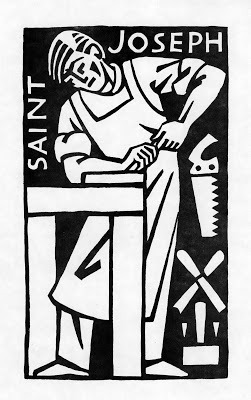
Woodcuts by Ade Bethune …
In the fifties,
another artist, Fritz Eichenberg, produced some stunning works of art for the
paper. Eichenberg, a Quaker, portrayed most sensitively in his woodcuts and
engravings the spirit of The Catholic Worker. His “Christ
on the Breadline,” “The Labor Cross,” and “Last Supper,” captured visually what
The Worker’s writers were trying to express in words. Day
wanted to touch those poorest of the poor who could not read so she often
printed full, front-page reproductions of Eichenberg’s work.
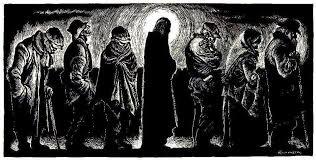
… and Fritz Eichenberg graced the pages of nearly every issue of The Catholic Worker.
The Catholic
Worker continued to be built around Dorothy Day’s writing. She
changed the name of her column to “On Pilgrimage,” a title that seemed to
describe the nature of her life.
Others contributed
articles regularly. Michael Harrington, a resident Worker who later became an
economist, consistently provided pieces for the paper. Harrington’s most famous
work, The Other America, written in 1961, is said to have
sparked the Kennedy/Johnson War on Poverty. Ammon Hennacy, a pacifist
anarchist, wrote extensively of his “one-man revolution.” Robert Ludlow, an
intellectual and lover of Gandhi’s principles of nonviolence—he wrote a
striking piece on Gandhi’s death—became an associate editor of the paper.
Columns about the day-to-day activities of the House of Hospitality and about
life on the farm provided engaging copy each month.
More Issues
The Catholic Worker continued to fight for justice
and peace. When the underpaid gravediggers of Calvary Cemetery—Catholics and
members of a CIO union—went on strike against New York’s Cardinal Spellman,
Dorothy Day supported the gravediggers. The Cardinal thought the strike was
inspired by Communists and refused to negotiate. He even used seminarians, of
all people, to break the strike and forced the striker to dissolve the CIO
affiliation and join an American Federation of Labor union instead. Day
criticized the Cardinal’s tactics and the “shameful seminarians” who broke the
strike.
At the onset of the
Nuclear Age, The Catholic Worker denounced the continued
testing of the A-bomb and the development of the H-bomb, and called for total
disarmament of nuclear weapons. Indeed, The Worker even
criticized the Catholic press for its “unbalanced” portrayal of Russia and its
people.
The paper also
opposed the anti-Communist Smith and McCarran Acts:
Although we disagree with our Marxist brothers on the question of the means to use and to achieve social justice, rejecting atheism and materialism in Marist thought and in bourgeois thought, we respect their freedom as a minority group in this country…. We protest the imprisonment of our Communist brothers and extend to them our sympathy and admiration for having followed their conscience even in persecution.
The paper continued to criticize the Capitalist system. “Communism,
considered as an economic system apart from its philosophy, is not so much the
antithesis, the opposite and the contradiction of Christianity as Capitalism
is.” Such critiques did not win the paper many friends in the highly charged
“Red-Scare” atmosphere of Joe McCarthy America. One priest wrote to ask The
Catholic Worker, “Why don’t you come out in the open, declare
yourselves Bolshevik Communists and fight the Church like men?” Day, a woman,
stood firm, even quoting the Popes and their attacks on economic materialism
and Capitalism.
Civil Disobedience
In 1955, seven Catholic Workers, including Dorothy Day and Ammon
Hennacy, staged a protest with twenty-three others from the War Resisters
League against New York City’s annual air-raid drill. The Civil Defense Act
required that all take shelter for at least 10 minutes.
The Workers
considered the drills scare tactics and war preparations; they would have no
part in them. The protesters informed the police beforehand of their intention
to violate the law. When the siren sounded, instead of heading for shelter, the
protesters sat on benches in City Hall Park. They were arrested and detained
for nine hours before being released on fifteen hundred dollars bail.
When their case came
to trial, the protesters made a statement explaining their brazen stance. They
said they did not wish to participate in an action aimed only at creating a war
mentality. Taking cover from an atomic attack was ridiculous, they said, and
they offered their action, and any punishment for it, as a small act of penance
for dropping the atomic bomb on Japan. The judge found them guilty but
suspended their sentence, so they served no jail time.
For the next four
years, Workers along with others continued their protests. They were jailed
each time for anywhere from five to thirty days. The Catholic Worker
carried accounts of the demonstrations and explained Workers’ rationale for
participating. Workers wrote about their own jail experiences and, thus, brought
public attention to jail conditions and to the lives of those so confined. In
1960, one thousand people showed up to protest the “war games,” as The
Worker dubbed them. When arrests were made, the Workers were passed
over, prompting Hennacy to ask one of the arresting officers if he wasn’t
shirking his duty. After 1960, the City gave up on its annual air-raid drills.
Slum Landlord
In 1956, Dorothy Day was handed a summons ordering her to appear before
a City judge to answer charges of being a slum landlord and of running a
firetrap. Since the thirties, The Catholic Worker had run
a House of Hospitality, with rooms and beds for those who had no home of their
own. The Houses were always liveable, although no one ever worried about
conforming to any housing regulations. When Day appeared in court, she
explained to the judge that The Catholic Worker was a
charitable organization and that the apartments were for those who had no other
place to live. “All the more reason for you to provide suitable housing” for
them, the judge growled. He fined her $250 and told her that she and her fifty
“tenants” would have to vacate in 10 days. Day was stunned.
Someone contacted The
New York Times, which picked up the story. Public outcry about the
incident caused the judge to apologize to Day, suspend the fine, and give her
enough time to raise the $28,000 needed to make the house conform with local
building codes. Because of the publicity, within a month most of the funds had
been donated and soon the House was refurbished to meet City standards. But
“Holy Mother City” had the last word. In 1958, the City informed Day and the
Workers that they would have to move to make room for a new subway line!
About Cuba
When Fidel Castro’s revolution in Cuba succeeded in 1959, The
Catholic Worker came out on Castro’s side. The paper’s critics were
outraged. How could a Catholic paper endorse a government opposed to the
Church? Even friends of The Worker were astonished and
thought the paper had compromised its pacifist position. Day answered both
critics and friends in the article “About Cuba.”
To her critics, Day said:
It is hard … to say that the place of The Catholic Worker is with the poor, and that being there, we are often finding ourselves on the side of the persecutors of the Church… . One could weep with the tragedy of denying Christ in the poor… . Fidel Castro says he is not persecuting Christ, but Churchmen who have betrayed him (in the poor)… . (Castro) has said that the Church has endured under the Roman empire, under a feudal system, under monarchies,
empires, republics and democracies. Why cannot she exist under a socialist state? He has asked the priests to remain to be with their people….
To her friends, she
said:
We are certainly not Marxist socialists nor do we believe in violent revolution. Yet we do believe that it is better to fight, as Castro did with his handful of men … than do nothing. We are on the side of the revolution. We believe there must be new concepts of property, which is proper to man … there is Christian communism and a Christian capitalism as Peter Maurin pointed out. We believe in farming communes and cooperatives and will be happy to see how they work out in Cuba.
The criticisms continued, however, and Day, at age 65, decided to go to
Cuba to report first-hand on Castro’s revolution. Her reports were printed in
her “On Pilgrimage” column from September through December of 1962. She
recounted day-to-day experiences among the Cuban people in a touching way that
gave her readers an idea of exactly what was happening to both Church and State
in Cuba. Many praised her Cuban reports as her best journalistic work. One
admirer wrote simply, “Thank you for your courage on Cuba.” After Day’s
personal reports on Cuba, the controversy stopped.
(To Be Continued)
This is Part IV of a series of articles on The Catholic Worker.