
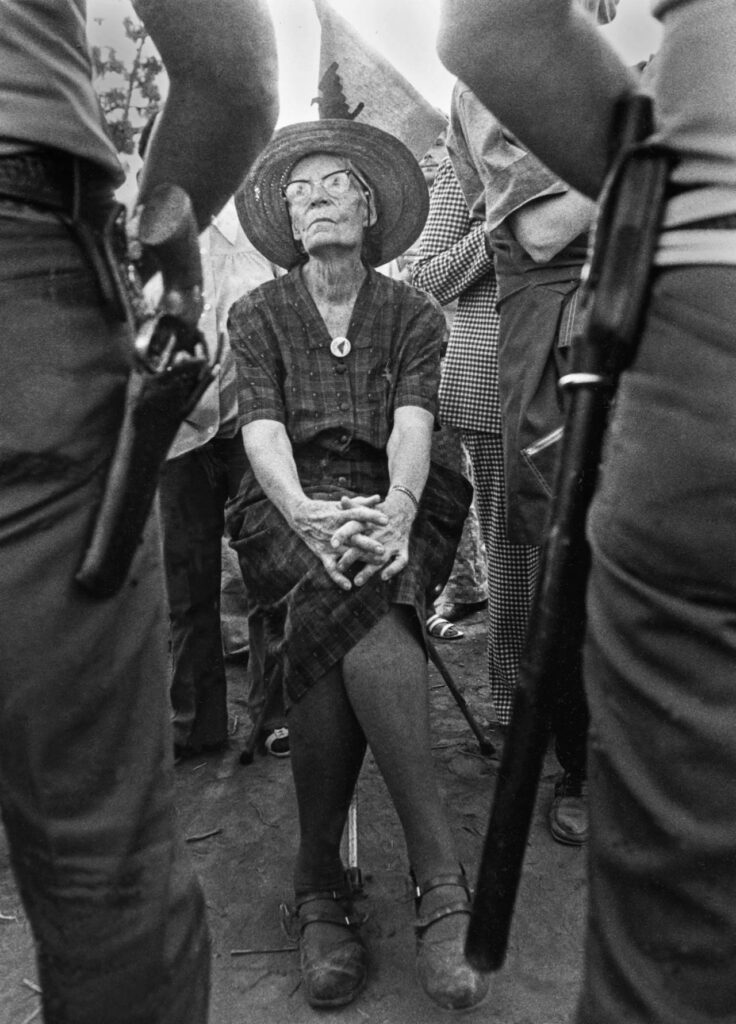
During this month of memorialization of the 50th
anniversary of the Kent State atrocity—where students protesting American
military aggression in Vietnam were gunned down on their own campus—it is well
to remember that The Catholic Worker staged the first public protest against
the Vietnam War way back in the summer of 1963 while this misguided attempt at
containing Communism’s spread was in its early stages. Read all about this and
more of The Catholic Worker’s incredible legacy of protest and resistance in
Part V, the last of my series on Dorothy Day and her pioneering newspaper.
* * * * * * * * * * * * * * * * * * * * * * * * * * * * * * * * * * * * * * * * * * * * *
Vietnam
The Catholic Worker began featuring the radical
pacifist writings of Cistercian monk Thomas Merton, as well as those of
brothers and Catholic priests Daniel and Philip Berrigan as early as 1959.
Others affiliated with The Worker organized the Catholic
Peace Fellowship, an organization aimed at educating Catholics on the Church’s
neglected tradition of pacifism. When news of the Vietnam War broke, The
Catholic Worker was ready.
The first demonstration ever held to protest the war was held by The Catholic
Worker in the summer of 1963. It was tiny, but after a ten-day
period, The War Resisters League brought two hundred and fifty people to join
the Workers. Together they made national television and launched the protest
movement against the war.
When Congress passed
a law in 1965 forbidding the burning of draft cards, The Catholic
Worker called for public draft card burning. David Miller, a Worker
volunteer, burned his card and caused an international sensation. Another
Worker, Tom Cornell, had gained some notoriety as early as 1960 by burning his
draft card at a demonstration against the launching of the Polaris submarine.
Later, five other Workers, including Cornell, burned their cards at a rally in
Union Square.
Dorothy Day heartily
supported the protests and spoke at the rally:
… I speak today as one who is old, and must endorse the courage of the young who themselves are willing to give up their freedom. I speak as one who is old, and whose whole lifetime has seen the cruelty and hysteria of war in the last half century….
I wish … to point out that we too are breaking the law, committing civil disobedience, in trying to encourage all those who are conscripted to inform their consciences, and to heed the still, small voice, and to refuse to participate in the immorality of
war.
Counter demonstrators across the street shouted at her, “Moscow Mary!
Moscow Mary!” Others yelled, “Give us Joy! Bomb Hanoi!” and “Burn yourselves,
not your draft cards.”
Roger Laporte, a Catholic Worker volunteer present at the rally, heard the cries of the
counter-demonstrators and, perhaps as a witness to others that he was willing
to do anything to stop the war, took their demands seriously. A few days after
the rally, at five in the morning, LaPorte bought a can of gasoline; walked to
the Secretariat Building of the United Nations; sat down on the landing of the
Isaiah Stairway under the words carved into the walls: “They shall beat their
swords into ploughshares, neither shall they study war anymore”; poured the
gasoline over himself and struck a flame. He died the next day. The incident
made international news.
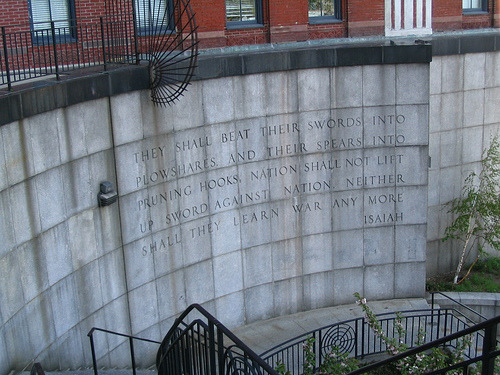
Isaiah Stairway at the United Nations Plaza in New York City.
The very night of Laporte’s self immolation, almost
as if Heaven wished to mark the sacrifice of this youth and the thousands more
that were to die in Vietnam, all the lights went out from New York City to Montreal.
It was the night of the Great Blackout of 1965.
The Catholic Worker came under heavy criticism by the Catholic press
for this action by one of its members. Although no one suspected LaPorte would
consider such an extreme measure, Dorothy Day felt some responsibility for the
tragedy. She never criticized LaPorte’s act, but she was badly shaken by it and
called for strenuous prayer and fasting. She prayed that Roger LaPorte’s
sacrifice would be accepted by God and that no one would follow his example.
The Catholic Worker continued its support of the Peace Movement. It
called for massive resistance to the draft and for men to refuse payment of
taxes that went to support the war effort. The Berrigans wrote lengthy articles
for the paper detailing accounts of their acts of civil disobedience against
the war.
When Cardinal Spellman went to Vietnam for his Christmas visit and called for victory in the
war, Dorothy Day decried his statement in the article, “In Peace is My
Bitterness Most Bitter.” She paraphrased Christ’s words, writing “Our worst
enemies are those of our own household,” and said, “What words are those he
(Spellman) spoke against even the Pope, calling for victory, total victory?
Words are as strong and powerful as bombs, as napalm.”
Viva La Huelga!
The Catholic Worker also took up the cause of
Cesar Chavez and exposed the plight of the migrant farm worker. Chavez was
trying to organize the vast migrant worker population into a union and, thus,
force growers into paying better wages and providing better treatment to the
migrants. The Catholic Worker brought national attention
to Chavez’s cause. The paper carried accounts of Chavez’s activities in the
fields of Delano, California, and of the increasing harassment by the growers.
The paper called for a boycott of non-union grapes and lettuce and for the
picketing of any supermarkets that did not carry union-approved products. [Some
of my fellow seminarians and I would make trips to local Baltimore supermarkets
on Saturday mornings in the early 1970s to test their produce and urge grocers and their customers not to buy scab, non-union grapes and lettuce.]
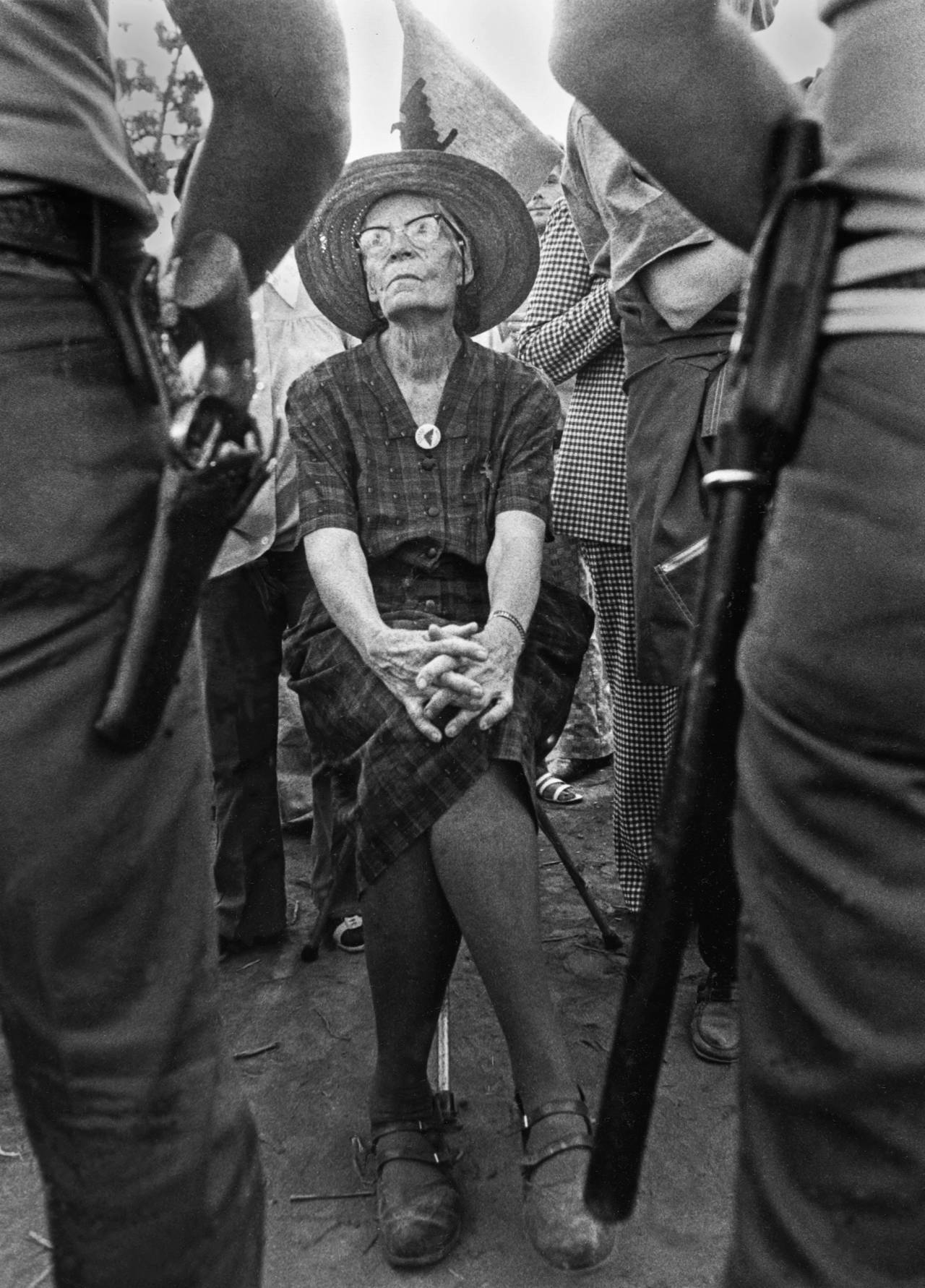
Dorothy Day’s final arrest was in collaboration with fellow Catholic Cesar Chavez and the United Farm Workers in 1973.
The Seventies
The Catholic Worker carried its opposition to the
Vietnam War into the 1970s. It continued to call for war tax resistance and
draft resistance. Letters or articles by the Berrigan brothers, written from
their jail cells, were prominently featured.
In the summer of 1971, Dorothy Day made another pilgrimage, this time to Russia. As in Cuba, she
recounted her experiences with the Russian people and reported on the country’s
economic conditions, as well as on how the Church was surviving alongside its
godless counterpart, the State.
In 1973, at the height of the United Farm Workers’ strike, Day went to Fresno to participate in a
non-violent demonstration aimed at bringing attention to the illegal jailing of
union members who picketed the growers’ fields. She went to jail with nearly one
hundred other demonstrators. She was 76 years old.
The Catholic Worker accepted articles from friends around the globe who
sought to bring attention to injustice in their own locales. Stories on Northern
Ireland terrorism, on Philippine repression, on strip mining in West Virginia,
on resistance in Brazil, on tragedies in Bangladesh, and on the Attica Prison
uprising all appeared in the paper, along with instructions in nonviolent
resistance and pieces on cooperative land-holding and voluntary poverty. The Worker’s outcries
against the U.S. nuclear weapons arsenal continued, as many Workers went to
jail because of their symbolic, attention-getting protests against the nuclear
arms buildup.
Dorothy Day’s Death – The Work Continues
Dorothy Day died in November of 1980, at the age of 83. Her
last years were spent in semi-retirement. She did not travel much after 1976,
when her health began to fail, but she continued each month to write her
journal “On Pilgrimage” for the paper. [I discovered through reading her
columns that Day was, indeed, at Maryhouse three years ago when we visited.
She was confined to her room, but her spirit permeated the halls of the place.]
While retired, Day continued to do what she could for the poor and dispossessed of this world.
Three hours before her death, she was on the phone begging for aid for the
victims of a devastating earthquake in Southern Italy.
The paper and the movement continue. Two Workers, Marj Humphrey and Peggy Sherer, edit the paper. Other Workers manage the two New York City Houses of Hospitality (Maryhouse and
St. Joseph House); they feed hundreds each day, and give shelter and clothing
to those who have none. The paper still relies on appeals in the Spring and
Fall for the means to continue the work. Marj says that it costs more than
$10,000 each month to print and distribution the paper, and that circulation
figures are back up to a healthy 95,000 (mostly as a result of the Anti-War
Movement of the sixties and seventies).
The paper still sells for a penny a copy (twenty-five cents for a year’s subscription) and is
intent on carrying on the work that Peter and Dorothy began almost fifty years
ago. Recently incidents in El Salvador, Guatemala, Chile, the Philippines, and
Korea have been highlighted—each article written by someone with first-hand
experience and knowledge of the horrors committed in these terror-torn
countries. One need not be a Catholic to submit an article or to work for the
paper—only subscribe to the basic tenants of the Catholic Worker philosophy.
Of course, there is
always room in the paper for one of Peter’s “Easy Essays” or for one of
Dorothy’s old articles, along with pieces about farming (The Worker
still maintains a farm in Marlboro, New York), about activities at the Houses,
and about the problems of being poor in New York City.
Concerning the
future of the work, Marj Humphrey says, “It’s all in God’s hands. We will
continue as long as He allows it.”
* * * * * * * * * * * * * * * * * * * * * * * * * * * * * * * * * * * * * * * * * * * * * *
In the final lines of her 1952 autobiography The Long
Loneliness, Dorothy Day remembered how it all started:
We were just sitting there talking when Peter Maurin came in.
We were just sitting there talking when lines of people began to form, saying “We need bread.” We could not say “Go, be thou filled.” If there were six small loaves and a few fishes, we had to divide them. There was always bread. We were just sitting there talking and people moved in on us. Let those who can take it, take it. Some moved out and that made room for more. And somehow the walls
expanded.We were just sitting there talking and someone said, “Let’s all go live on a farm.”
It was as casual as all that, I often think. It just came about. It just happened… .
The most significant thing about The Catholic Worker is poverty, some say. The most significant thing is community, others say. We are not alone any more.
But the final word is love. At times it has been, in the words of Father Zossima, a harsh and dreadful thing, and our very faith in love has been tried through fire… It all happened while we sat there talking, and it is still going on.
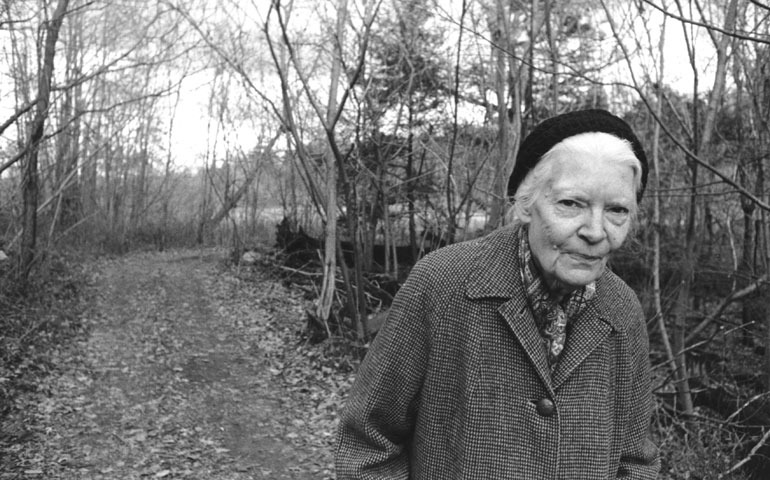
“It is still going on,” and it is a comforting thought that the work
will continue as long as God allows it. With any luck, He’ll allow it to go on
forever, or at least until the need no longer exists.
* * * * * * * * * * * * * * * * * * * * * * * * * * * * * * * * * * * * * * * * * * * * * *
This ends my series on Dorothy Day and the Catholic Worker Movement and newspaper.
For more information about Dorothy Day and her legacy, check out the new biography by John Loughrery and Blythe Randolph [Dorothy Day: Dissenting Voice of the American Century] and the new documentary by Martin Doblmeier [Revolution of the Heart: The Dorothy Day Story]