
Second in a Series on the Federation of Southern Cooperatives
I’m reading a little-known but important work by former U.S. Labor Secretary Ray Marhsall and former Ford and Rockefeller Foundations executive Lamond
Godwin called “Cooperatives and Rural Poverty in the South”, published in 1971 by Johns Hopkins Press. It discusses the very things I wrote about this summer in “50 Years of Courage, Cooperation, Commitment & Community”—the 50th Anniversary Commemorative book on the Federation of Southern Cooperatives. Even then, back in 1971, it was clear that the South needed cooperative organizations to help break through the cultural barriers to Blacks in agriculture. Thankfully, the Federation of Southern Cooperatives came along. Here is its foundational story… .
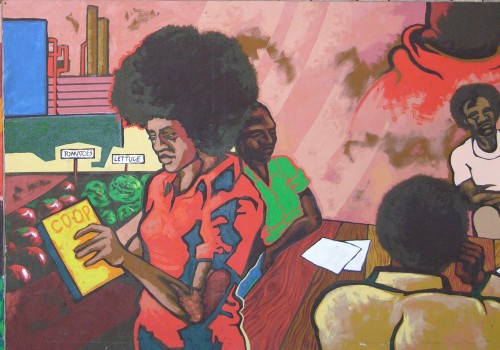
Mural (partial) at the Federation’s Rural Training Center in Epes, Alabama, created by the noted artist and graphic designer Donald Alexander (aka, ALDOX), from Lafayette, Louisiana–a hotbed of cooperative development in the 1960s.
It is difficult to precisely pinpoint how the idea of creating Southern Black-owned cooperatives initiated. Agricultural cooperatives, of course, were nothing new in America. The Midwest abounded with
them, as did the segregated South. They were a way for farmers to realize
economies of scale in the purchase of seed and fertilizer, to coordinate the sale
and marketing of their crops, to gain some power in a volatile agricultural
marketplace. They were also a way to exert some control, since the co-op was
owned by the farmers it served. None of these points were lost on the Blacks
who were trying to find a way out of the restrictive stranglehold of the White
power structure. Surely the influence of the union and other collectivist, progressive movements of the 1930s and ‘40s also had a lasting impact.
Whatever the genesis, it was in the late 1950s that the idea of forming locally based farmer cooperatives seemed to take hold. One instigator was the Reverend A. J. McKnight, a Catholic priest from Brooklyn who had joined the Holy Ghost (Spiritan) Order and was assigned as pastor to an impoverished Black parish in Lafayette, Louisiana. McKnight was charged up with a fire to improve the lot of his parishioners and immediately began holding voter registration and literacy classes in the hope of helping the indigenous Black populace to gain a level of political power. But when few folks showed up for the classes, McKnight was stunned. Surely, they must want their freedom!
Wisely, McKnight began holding listening sessions to determine the “felt needs” of the community, rather than imposing his own vision of what was required. “One need that surfaced many times was how
difficult and how expensive it was to borrow money,” McKnight would later
write. With this insight, he realized that the first brick in what he was hoping
would be a vast Southern cooperative structure was to create credit unions so
that individuals in low-income communities could have access to capital. Because of the inherent difficulties with growing a capital base with limited funds in low-income communities, however, McKnight eventually struck upon the idea of creating a regional investment cooperative that could attract funding from outside sources and become the mechanism for funding all manner of cooperative enterprises. This became the Southern Consumers Cooperative (SCC), established in 1964. McKnight used to enjoy boasting, as he did in his autobiography Whistling in the Wind, that SCC “received the first loan in the War on Poverty”—$25,000 to help start one of SCC’s subsidiaries, a bakery called Arcadian Delight, which offered fruitcakes and other Creole delicacies and helped put people to work. SCC formed a number of other subsidiaries, including an education arm (Southern Consumers Education Foundation) and a capital development and lending arm (People’s Enterprise).
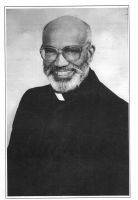
Reverend A.J. McKnight–a leader in the creation of the Southern Black Cooperative Movement.
Besides his fervor for cooperatives, McKnight’s very presence in southwest Louisiana was revolutionary. He was the first Black priest the parish had ever had. “It was a big deal,” said Carol Prejean, who was ten-years-old at the time McKnight arrived in the 1953. She and her older brother Charles began hanging out at the church, trying to imbibe the fresh wind of change that McKnight was preaching. McKnight seemed to embolden local Blacks to think bigger than they ever had before, to create their own institutions, to work their way out of the grinding poverty and dependence on the White ruling class that had characterized their existence for generations. Charles Prejean was smitten with McKnight’s fervor and determined that he, too, would become a priest. After a few years at seminary, however, he realized that a celibate life didn’t suit him, so he returned to Lafayette to work with McKnight and help build the cooperative institutions McKnight had begun dreaming up. “I came to the understanding,” Prejean said, “that the sense of communal life that I was being taught in the seminary was transferable—working in a community for the betterment of the community.” Prejean first volunteered with McKnight as a
community organizer while teaching at the local Catholic high school; then he was brought on full time, first at People’s Enterprise and later, when McKnight was
forced to spend more of his time on pastoral work, as general manager of SCC.
But McKnight and the Prejeans were not the only cooperative boosters in the South. Indigenous cooperative institutions seemed to spring up
everywhere all at once, usually sparked by a local need that could not be
filled by other means and often spurred by White intransigence. For
instance:
· When farmers and sharecroppers working for voting rights in west Tennessee were denied the ability to buy gasoline for their tractors from local White-owned gas stations, they started driving to the Missouri bootheel, just over the state line, to buy gas and oil and trucked it back home. Thus, the Mid-South Consumers Oil Co-op was born.
· When a group of impoverished Black women in rural Alabama showed their handmade quilts to a Northern Episcopalian priest, he arranged for their wares to be shown at craft fairs up North where he knew a ready market would be enthralled. Thus, the Freedom Quilting Bee was born.
· When a group of Black sweet potato farmers realized they could break up the White landowners’ purchasing and distribution monopoly in St. Landry Parish, Louisiana, by working together, the Grand Marie Vegetable Producers Co-op was born.
· When sharecroppers in Sumter County, Alabama, got involved in advocating for equal rights and were evicted from the land their families had farmed for generations, forty of these families banded together to find a way to purchase their own land. Thus, the Panola Land Buying Association (PLBA) came into being.
· When Black farmers in ten Black Belt counties of Alabama began comparing notes, they realized they could likely get a better price for their cucumbers, okra, and peas if they were to combine their output and mass market their crops. Thus, the Southwest Alabama Farmers Cooperative Association (SWAFCA) was born.
It was these start-up co-ops that formed the nucleus of what would become the Federation of Southern Cooperatives. We have Al Ulmer to thank for pulling them all together. Ulmer was director of community outreach for the
Southern Regional Council and had spotted a trend in majority Black counties
throughout the South. It was Ulmer who invited and underwrote the travel
expenses for representatives of ten of these emerging co-ops to a meeting in
the spring of 1966 at the Mount Beulah Center, a church-based conference center
just west of Jackson, Mississippi, where civil rights groups often met.
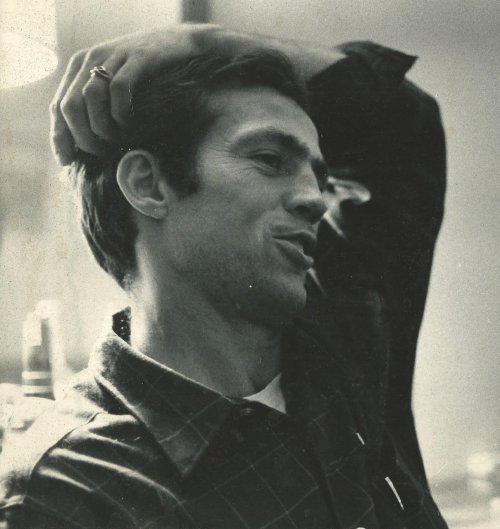
Al Ulmer, Director of Community Outreach for the Southern Regional Council, identified a trend among rural Blacks for developing self-empowering cooperatives and invited their leaders to a gathering in Edwards, MS, which would become the foundational meeting of the Federation of Southern Cooperatives.
Once gathered, co-op representatives swapped information, learned more about each other’s cooperative enterprises, and began to conceive of a plan to coordinate and scale up their activities. All of them—each in their own sectors—were up against incredible odds, given the harsh racial climate of the times. Black people were not supposed to be successful. They were only supposed to thrive if they served and were subservient to the Whites in power. They weren’t supposed to create their own pathways to power or economic security. But as is the case in all societies, the poor find their own ways to survive, often outside of the established norms. They “make a way out of no way.” In the rural South of the 1960s, cooperatives seemed like one of the best ways to a better future.
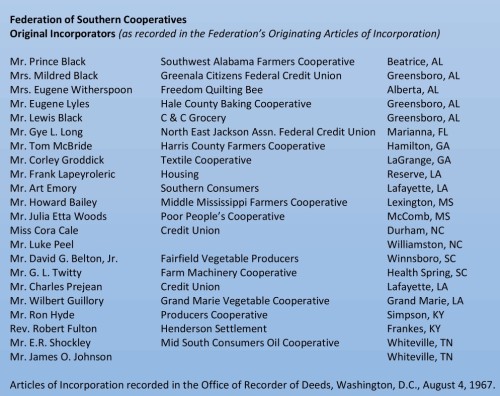
The Mount Beulah meeting led to a second gathering—again arranged for by Ulmer—in February of the following year, this time in Atlanta on the campus of Atlanta University. Those in attendance—22 representatives from various cooperatives in nine states throughout the South—agreed to establish a
loose confederation of cooperatives to help them coordinate their activities
and find ways of making each individual cooperative stronger. They called this
new organization the Federation of Southern Cooperatives.
NEXT: Carol Prejean’s Documentary Poetry of the Federation and a John Lewis 50th Anniversary Tribute.