
Fourth in a Series on the Federation of Southern Cooperatives
Every movement has its poet, its chronicler, it’s creative voice. For the Federation
of Southern Cooperatives, that voice—for its entire 50 years—has been Carol
Prejean Zippert. As a young girl, Carol became enthralled with Father McKnight
and his organizing for black economic empowerment. She and her brother, Charles
(who would become the Federation’s first Executive Director), were present when
the Federation was incorporated. And she would be part of the Federation’s
fabric for its entire first 50 years—and is still active in the organization’s
life and work. [She now serves as President of the Friends of Greene County
Employees Federal Credit Union, a Federation member.]
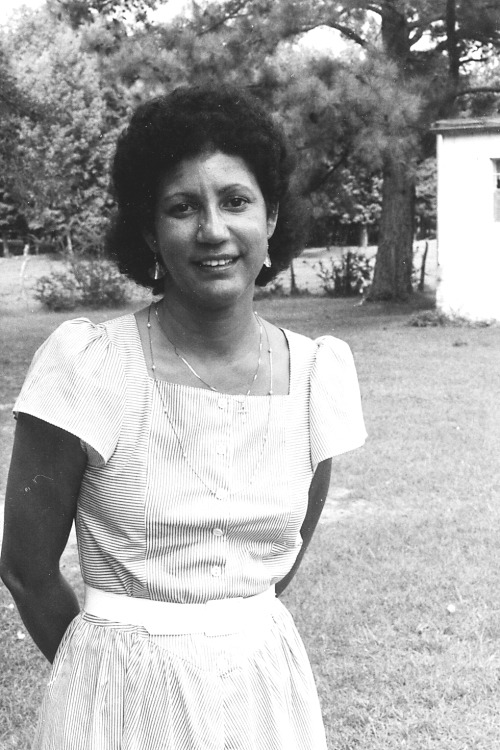
Carol Prejean Zippert in the 1980s, about the time she began
writing poetry for and about the Federation of Southern Cooperatives.
At some point in the 1980s, Carol began writing poetry, some of
it focused on the Federation and its work. Her poems became regular features in
the Federation’s annual reports and she would be a welcome speaker at the
co-op’s annual meeting, reading her most recent creation to an enthralled
membership.
Included below is the poem we chose to lead off the 50th anniversary commemorative book: One Day We Created a New Family. It perfectly summarizes the why and the how behind the
Federation’s long and storied history. Following the poem is a brief
biographical sketch of Carol and her husband of more than 50 years, activist and
long-time Federation employee John Zippert. Be inspired!
One Day We Created A New Family
By Carol Prejean Zippert
One day when we needed
new birth to help us discover
our history, live our culture
and pursue our justice,
we created a new family.
One day when we needed
to reclaim our dignity and respect,
when we needed to lift our heads
and open our eyes and minds,
we created a new family.
One day when we needed
to find our sisters and brothers
in struggle and form a bond
for our mutual survival
we created a new family.
One day when we needed
to save our children
to extend their lives and learnings,
when we needed to prepare them
as community-directed leaders,
we created a new family.
One day when we needed
to rediscover God’s earth
and all its gifts, to appreciate the soil,
waters, all living creatures and resources,
we created a new family.
One day when we needed
to save our land, build our houses,
provide for our healthcare,
secure our right to vote,
and assert our political leadership,
we created a new family.
One day when we needed
to form a more responsive society,
when we needed to secure more
loving communities,
we created a new family.
One day when we needed
a new family
for ourselves and for our children,
for our communities and for our nation,
One day when we needed to celebrate God’s world
We created a new family,
We created the Federation –
the FSC family.
One day we needed
a new family.
©2017 Carol Prejean Zippert
Carol’s
two volumes of poetry, I Don’t Want to Be Rich, Just
Able and Meeting Myself ‘Round the
Corner, both published by NewSouth Books (Montgomery, AL) can be
ordered by writing to her at P.O. Box 82, Eutaw, Alabama 35462.
John and Carol (Prejean) Zippert
John and Carol met while working in the civil rights and
cooperative movement in southwest Louisiana. John was a volunteer and later
field staff with the Congress of Racial Equality in St. Landry Parish,
Louisiana. John was working on registering minority voters, integrating public
accommodations and helping sweet potato and vegetable farmers to develop a
cooperative to market their produce.
Carol was working with the Southern Consumers Cooperative while
attending the University of Southwest Louisiana. She participated in a special
program to study cooperatives and credit unions nationally and internationally
in Canada and Turkey.
When John and Carol decided to get married in 1967, they had to
sue the State of Louisiana to remove its miscegenation statute to allow them to
get a marriage license. Partners in both life and the pursuit for racial,
social, and economic justice in the U.S. South, John and Carol (Prejean)
Zippert continue to embody the principles and priorities of the two movements
that shaped their lives—the civil rights movement and the cooperative movement.
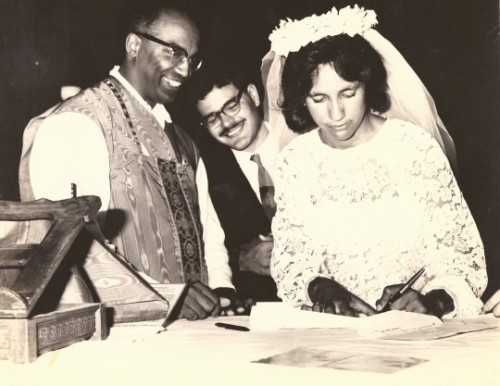
Rev. A. J. McKnight after officiating at the marriage of John
Zippert and Carol Prejean–the first such marriage in the state of Louisiana
after the U.S. Supreme Court ruled in Loving v. Virginia that bans on
interracial marriage were illegal.
Father A. J. McKnight first kindled the couple’s passion and
commitment to the cooperative movement. The same year they were married, the
Federation of Southern Cooperatives was chartered. John and Carol were involved
as community organizers with the cooperatives and credit unions and
participated in the meetings that resulted in the formation of the Federation.
John and Carol’s lives progressed in parallel with the mission of the
Federation and the growth of the cooperative movement in the South.
For nearly five decades, John has worked for the
Federation. For the past quarter century, he has served as the Director of
Program Operations for the Federation at its Rural Training and Research Center
in Epes, Alabama, where he has promoted cooperative economic development for
low-income and minority people in ten Southeastern United States. In the wake
of Hurricanes Katrina and Rita, John expanded the Training Center’s reach to
include relief work, enlisting cooperatives to help individuals, families, and
other co-ops to recover and rebuild along the Gulf Coast.
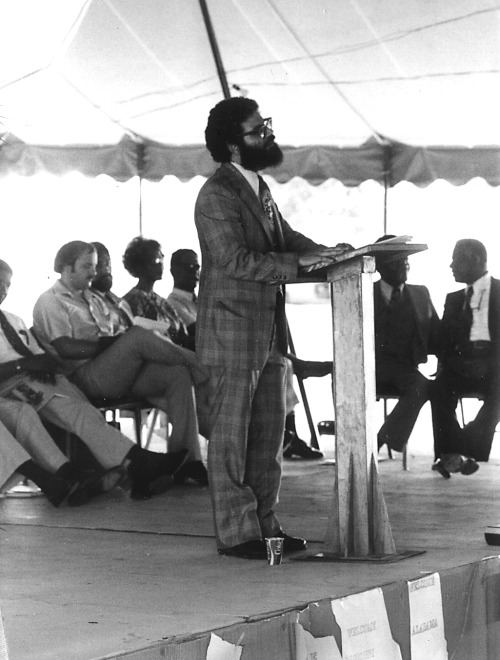
John Zippert speaking on behalf of the Federation of Southern
Cooperatives in the 1980s.
During his career at the Federation, John has trained staff,
mentored countless young people and designed programs to further sustainable
small farming and cooperative development. The Federation honored John’s
dedication with its Staff Award in 1977, 1978 and 1996.
John serves on the board of numerous state and national
organizations, including the Rural Coalition, Rural Development Leadership
Network, Alabama New South Coalition, Alabama Black Belt Commission, and
others. John has been involved in advocacy and public policy development for
family farmers, as well as for rural and cooperative development. He also
assisted hundreds of African-American farmers in filing successful claims in
the Pigford Class Action discrimination lawsuits.
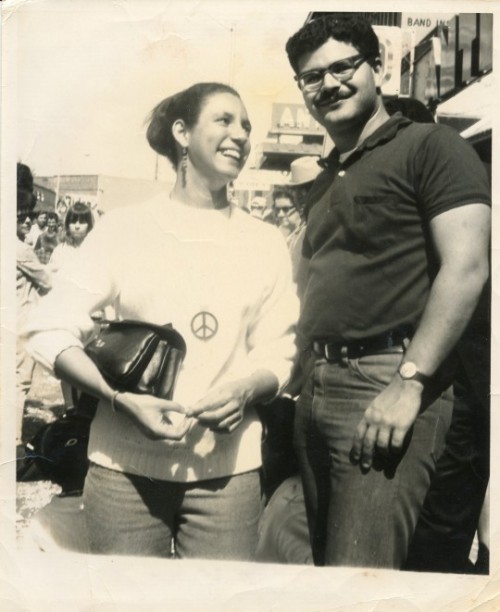
John and Carol in the late 1960s.
In 1985, Carol earned her Ph.D. in Educational Leadership,
Supervision, and Curriculum Development from the University of Alabama,
Tuscaloosa. As a self-described “community worker,” she dedicated five decades
to building leadership and developing co-ops with the Federation—where she
continues to volunteer—as well as supporting grassroots community groups in
their work to achieve social transformation. Carol has served as an adjunct
research professor and resource specialist for Tuskegee University’s
Community-Based Youth Partnerships. She has been involved with the 21st Century
Youth Leadership movement since its inception in 1986 and continues to serve on
its board.
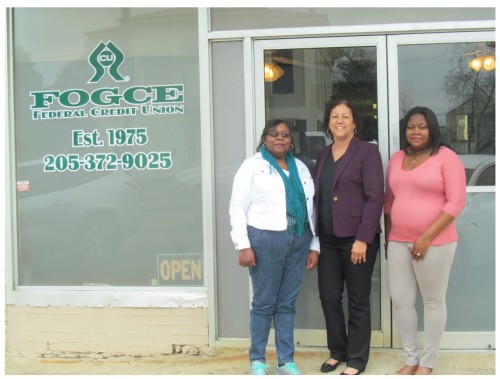
Carol Prejean Zippert (center) serves as president of Friends of
Greene County Employees Federal Credit Union. She is standing in front of the
credit union’s new headquarters on the Eutaw (AL) town square with manager
Joyce Pham (l) and accounting clerk Kiera Epps ®.
Carol is also president and founder of the Federation of Greene
Country Employees (FOGCE) Federal Credit Union. Under her leadership, low-income
people of one of the poorest counties in the U.S. built a credit union that has
accumulated more than $1.4 million in assets. In addition, Carol’s poetry and
leadership in cultural organizations such as the Black Belt Community
Foundation and the Greene County Society for Folk Arts and Culture strengthen
connections and trust among people, their co-ops, and their communities.
Since 1985, John and Carol have together published the Greene
County Democrat Newspaper, a weekly publication to inform and educate their
primarily African-American community.
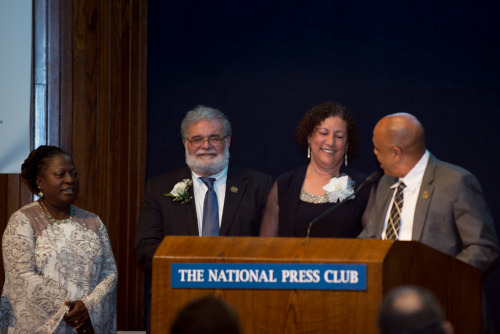
John and Carol Zippert (center) at the Co-op Hall of Fame induction ceremony in May 2017 at the National Press Club in Washington, DC.
In 2017, the couple was inducted into the Cooperative Hall of Fame, the highest honor awarded to cooperative activists, sponsored by the Cooperative Development Foundation and the National Cooperative Business Association.
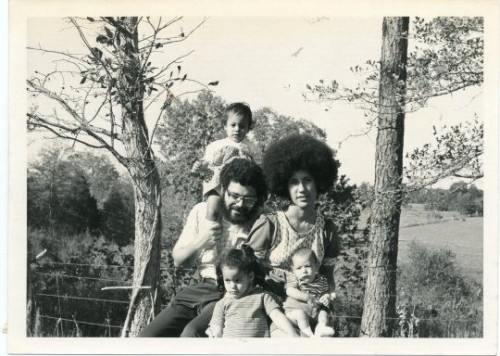
John and Carol with their three children at the Federation’s Rural
Training Center in Epes, Alabama, in the 1970s.