
Fifth in a Series on the Federation of Southern Cooperatives
Washington, DC loves political drama, whether it’s delivered daily through the news media or in the form of a retrospective. As we have enough of the former lately, it is instructive to have one of America’s most tumultuous periods served up to us through Arena Stage’s production of The Great Society, the newest play from Robert Schenkkan, whose All the Way won the Tony Award in 2014 and went on to be a blockbuster HBO TV film. All the Way chronicles the first year of LBJ’s presidency,
from the assassination of John F. Kennedy to Johnson’s coronation as the
Democratic nominee for President at the 1964 convention in Atlantic City. The
Great Society picks up the thread right after that historic moment and
carries us through the next chaotic four years of Johnson’s administration:
through Selma, the passage of the Voting Rights Act, the creation of the Medicare
and Medicaid programs, the Watts riots, the Black Power movement, and,
tragically, the escalation of the Vietnam War, which would sap the energy and
the funding from Johnson’s grand vision of creating an American “Great Society.”
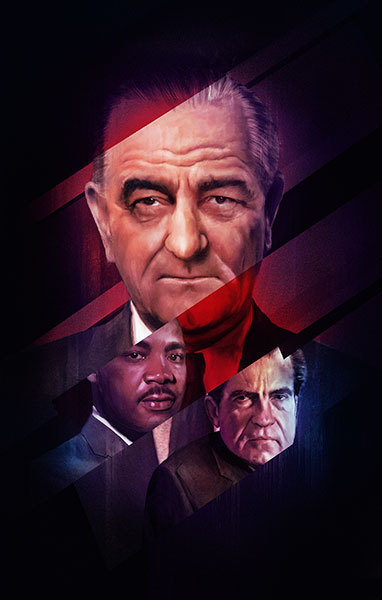
Arena Stage’s The Great Society. Art work by Richard Davies Tom.
Though the play (and the period) deserve their own epic review, I use the currency of the play’s premier in Washington to introduce the next section of my series on the Federation of Southern Cooperatives. It was, after all, Johnson’s Great Society program that helped launch the Federation 50 years ago and which funded many of its most innovative early projects before the program fell out of favor with Congressmen and local politicians, who wanted to control the federal funding project and use it for patronage rather than for serious improvement. Here is the Federation’s history in summary form detailing its connection to Johnson’s great achievement and how it helped
provide the foundational support for an enduring cooperative legacy.
LBJ’s Great Society and War on Poverty
The 1960s were a time of great optimism, despite the social upheaval. President John Kennedy had committed to putting a man on the moon by the end of the decade. President Lyndon Johnson, in his first Inaugural Address less than two months after Kennedy’s assassination, declared a War on Poverty and the creation of a Great Society that would, he hoped, rival President Franklin Roosevelt’s New Deal. There was the belief that if enough resources
and focus could be brought to an endeavor, all things were possible and any problem could be solved, even the gnawing, persistent poverty that plagued much of the South.
In 1965, the Office of Economic Opportunity (OEO) was formed—a
result of Johnson’s massive legislative push the year before, which included
the Civil Rights Act of 1964, the Criminal Justice Act of 1964, the Food Stamp
Act of 1964, and, of course, the Economic Opportunity Act of 1964. [The Voting Rights Act—the crown jewel of
Johnson’s legislative achievement—would come in 1965.] Nearly a billion
dollars were earmarked for the fight against poverty. Funds would be
distributed through Community Action Programs, some of which could be independent
of state control so that funds could go directly to worthy projects—even
experimental ones—that held the promise to raise the economic prospects for
those most impoverished. The OEO legislation called for “maximum feasible
participation” by the poor themselves—a clear signal that this effort was meant
to be something other than business as usual. A special carve-out was provided
in the legislation for cooperatives. Specifically, under Title III—Special Programs to Combat Poverty in Rural Areas, the
law stated:
The
Director is authorized to make loans to local cooperative associations
furnishing essential processing, purchasing, or marketing services, supplies,
or facilities predominantly to low-income rural families.
Many community organizers from the established civil rights organizations—SNCC, CORE, SCLC and even the NAACP—took hold of this language and began forming cooperative institutions in their areas that they believed could bypass the existing White stranglehold over agricultural production and marketing, as well as its lock on political patronage. The hope was that cooperative institutions would open up new opportunities for the impoverished Black citizens while educating them about basic principles of democratic participation as infused in the cooperative model. Co-ops would become, in the words of SCLC’s Albert Turner, “the economic arm of the civil rights movement.” [It was Turner who would as a catalyst for the Selma to Montgomery March by insisting that the murder of Jimmie Lee Jackson be publicly addressed.]
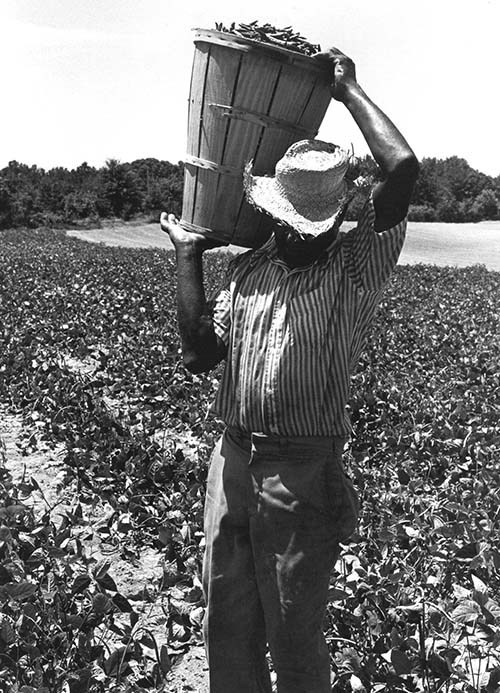
Work on a Federation-member rural agricultural cooperative in the 1970s.
Thanks to the Economic Opportunity Act of 1964, millions of federal dollars began flooding into the South beginning as early as 1965. The beneficiaries of some of these funds were newly formed cooperatives that had been struggling to find a foothold. Such organizations as the Southwest Alabama Farmers Cooperative Association, Ezra Cunningham’s organization, and the Southern Consumers Cooperative—McKnight’s and Prejean’s initiative, received
grants for a variety of “demonstration projects” to prove that their programs
could, in fact, work to improve the conditions of the rural poor.
The Federation was a direct beneficiary of this early War on Poverty largesse. In addition, its initial funding came from the Cooperative League of the USA (CLUSA)—a forerunner of today’s National Cooperative Business Association—in the form of a $35,000 grant which derived from CLUSA’s own larger OEO-funded cooperative development project. [Additional start-up funding was provided by the Aaron Norman Fund and the New York Foundation.] Indeed, CLUSA’s Merlin Miller and Chuck Ihlenfeld were present when the idea for the Federation was hatched at Mount Beulah.
More front-end funding and encouragement came from the
International Self-Help Housing Association (ISHHA), a Quaker-initiated
organization; from the Southern Regional Council, a White progressive group
working for equality in Southern race relations which by this point was running
the important voting rights initiative, the Voter Education Project; and from
the National Sharecroppers Fund, an advocacy group for sharecroppers and tenant farmers that grew out of the Southern Tenant Farmers’ Union. Thus, the various threads of the progressive movement—cooperatives, religious, civil rights and economic justice groups—coalesced to form what would become a potent mechanism for the empowerment of some of the least powerful citizens in America. The next fifty years would be a thrilling, if bumpy, ride for the Federation.
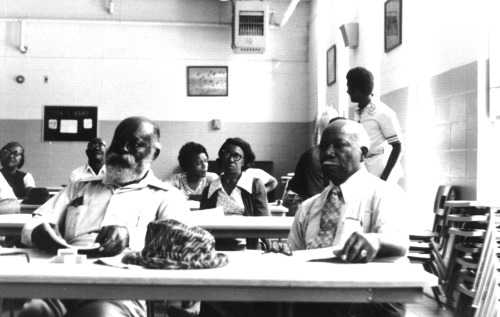
An early Federation training session (1970s) for Black farmers.
Uphill Battle
It is instructive to consider that, aside from the Federation’s initial explosive growth and the federal and foundation funding it attracted in the late 1960s, the organization was fighting an uphill battle
almost from the start. Two major factors ensured this Sisyphean struggle would
continue: the lack of political will to continue the War on Poverty and the all-pervasive and blatant discrimination against Black farmers practiced by Southern federal government employees who were accommodated by their superiors all the way up the line to Washington, DC.
First, the Nixon administration, which took over the reins of federal government in 1969, began systematically dismantling President Johnson’s Great Society programs, starting with the OEO. Nixon put young Illinois Congressman Donald Rumsfeld in charge of the agency. Rumsfeld quickly spun-off the most popular programs to other agencies (Job Corps to the Department of Labor; Head Start to HEW), thus weakening the OEO’s cabinet-level status.
Rumsfeld also started a process of defunding some of the more successful
programs or forcing expensive evaluations of their poverty-fighting methods. In early 1973, at the start of Nixon’s second term, the President further gutted the agency by removing any budgetary allotment for Community Action Programs—the very ones that were funding the Federation’s grassroots
cooperative organizing efforts and those of its members. “After more than 7
years … further federal spending on behalf of this concept, beyond the $2.8
billion which has already been spent on it since 1965, no longer seems necessary
or desirable,” Nixon told Congress that year.
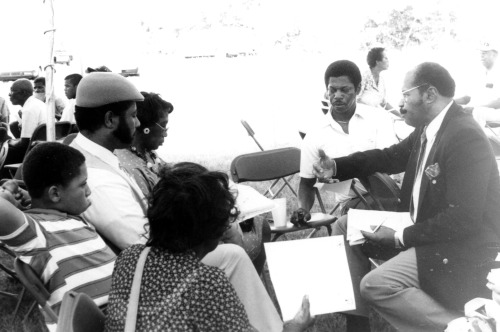
Discussion at one of the Federation’s earliest Annual Meetings (1970s), just as the Nixon Administration was busy cutting back on the War on Poverty.
The OEO continued to limp along in various guises until another conservative reformer, President Ronald Reagan, broke it up completely in 1981. Reagan would later cynically—though cheerfully—say in his weekly radio address, “In 1964 the famous War on Poverty was declared and a funny thing happened. I guess you could say, poverty won the war.” It wasn’t funny to those in the rural areas of the Deep South who were trying to make it on less than $1,000 a year. Fortunately for them, the Federation had begun to diversify its funding sources so that even in the Nixon years, significant dollars came from a variety of federal and state agencies, as well as foundations and church-based groups.
By 1973, for example, only 5% of the Federation’s $1.5 million income was derived from OEO funding. Significantly greater amounts came from the U.S. Commerce Department’s Office of Minority Business Enterprise
($613,000) and the Department of Health, Education, and Welfare (nearly
$300,000 for jobs training programs and $110,000 for the Black Belt health care
initiative). Much of the rest of the funds came from various foundations and
church groups, including the Rockefeller Brothers Fund ($150,000), the Ford
Foundation ($92,000), and the Field Foundation ($77,700). An impressive $24,000 was raised from staff contributions.
For more information about the War on Poverty and how it played out in the rural South, consult Susan Youngblood Ashmore’s Carry It On: The War on Poverty and the Civil Rights Movement in Alabama 1964-1972
Next: Charles Prejean, the Federation’s first leader, jump starts the rural cooperative movement in the South.