
Sixth in a series about the Federation of Southern Cooperatives
When the group of 22 individuals signed on to the new Federation’s Articles of Incorporation and Bylaws in 1967, their first official act was to choose a leader. Charles Prejean, was an obvious choice. Because of his growing role in cooperative development in Louisiana, Charles Prejean had been invited to be present both at the Mt. Beulah meeting and at the birth of the Federation in Atlanta. Others who would become dynamos of the Southern Cooperative Movement were also in attendance, including John Zippert, Prejean’s sister Carol, Estelle Witherspoon, G. L. (Gonze) Twitty, and Lewis Black.
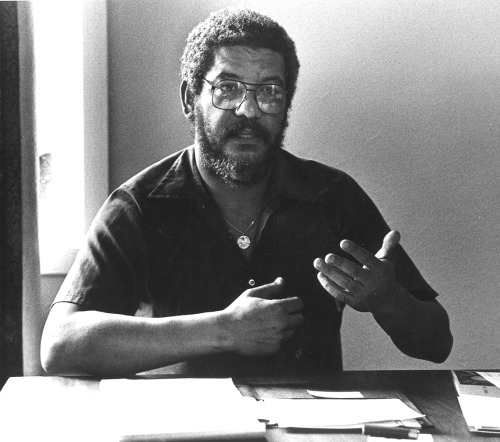
Charles Prejean in the 1970s, explaining the mission and purpose of the Federation of Southern Cooperatives.
Charles Prejean became an original signatory to the Articles of Incorporation and despite his relative youth—he was only 26 years old at time of the Federation’s formation—he was chosen by the other signatories to serve as the president of the newly formed Board of Directors. It was a prescient choice. Prejean would lead the organization—first as President, then as Executive Director—through its formative and spectacular growth years, as well as through some of its most difficult days. For the next 17 years, Prejean would be at the helm, securing federal grants from the OEO and other federal agencies, attracting substantive funding from leading foundations, and inviting churches and other charitable organizations to help aid the Federation’s social welfare mission.
The Federation’s Mission
and Purpose
When Prejean and others drafted the Federations Articles of Incorporation and Bylaws, they spent a substantial time determining the newly forming organization’s purpose statement, what we would now call its mission. The 34 long lines of text—presented as a single sentence—provide a short course
in cooperative development. Some excerpts follow.
The purpose for which the Federation is organized are:
- for primary and mutual benefit of patrons of the association as ultimate consumers;
- to promote region-wide programs and institutions for the training of persons interested in the formation and development of all types of cooperatives;
- to act as a clearing house and data bank of information relating to the different types of cooperatives;
- to make technical and financial resources available to existing cooperatives and to persons wishing to organize a cooperative or association of cooperatives;
- to aid cooperatives in ascertaining alternative means of supply and distribution;
- to engage in research relevant to economic development or cooperative expansion;
- to serve as a clearing house for potential resources, financial assistance and technical help for cooperatives;
- to promote the organization of state associations of cooperatives;
- to assist, defend and protect the cooperative movement;
- to engage in any activity in connection with the marketing or selling of agricultural or
manufactured products of its members; - to finance by loan, grant or purchase any of the aforementioned activities.
Clearly the drafters were thinking big, expecting their small group of originating cooperatives to expand in scope while also assuming that the concept of agricultural and handicraft cooperatives and credit unions would catch on as a way for low-income farmers and rural people to create their own institutions, improve their economic situations, and provide meaningful employment for themselves and their communities. It was a revolutionary concept that shattered the stereotype of the shiftless Southern Black agricultural worker who needed an overseer to ensure that any work got done. Here, those very people were taking their destinies into their own hands, working cooperatively for a better future, and inspiring others to do the same.
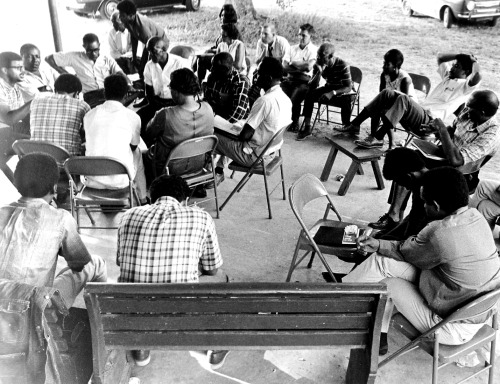
A caucus of members meet to discuss policy direction for their cooperative at a Federation annual meeting in the 1970s.
The incorporators’ grand vision paid off. In 1968, OEO came through with its first grant of nearly $600,000. “That really was the take-off point for the Federation of Southern Cooperatives,” Prejean would later say. Within a year, the Federation’s membership base had more than doubled, with 45 member-cooperatives, serving about 10,000 low-income families. By the end of 1971, that number had jumped to 110 cooperative members—exactly five times the number of initial incorporators—serving approximately 30,000 families.
A Funding Source to
Support Struggling Co-ops
One issue that Prejean identified early in his tenure was the fact that much of the federal and foundation funding was directed for specific initiatives or earmarked for only certain types of cooperative development support, like providing technical advice or training. There were no funds to assist financially struggling cooperatives meet their bottom lines. “The response to the Federation has been great,” he wrote to Leslie Dunbar, former head of the Southern Regional Council who was by now running the Field Foundation, “but I am beginning to become frustrated because we have resources to help with so few of the problems of cooperatives.”

The logo of Southern Regional Council–a 1940s civil rights organization that helped organize the Federation of Southern Cooperatives.
The solution was to create a revolving funding mechanism that would enable co-ops to get grants or loans directly from their own institution rather than having to attempt to obtain loans from banks or other established financial institutions unlikely to loan funds to an organization
run by low-income people. In January 1969, the OEO provided a $500,000 grant to the Federation to establish the fund, which became the Southern Cooperative Development Fund (SCDF). At Prejean’s recommendation, the Federation board recruited Father McKnight to become the director of the new entity. The Federation had authority to appoint a majority of the board members to oversee the fund’s operations. Within a few years, SCDF had made loans totaling almost $3 million to Federation member-cooperatives for various operational improvements. Additionally, thanks to grants from the federal government and various foundations, SCDF’s assets had grown to nearly $8 million Thus, SCDF became the financier of the burgeoning Southern cooperative movement, while the
Federation provided on-site consulting services as well as some limited grant
assistance to ensure its member-cooperatives’ success.
How it All Worked
In the 1971 annual report, Prejean provided a number of success stories from the Federation’s various enterprises. These vignettes offer
a glimpse into the fledgling Federation’s scope and impact:
- At Grand Marie Co-op, Sunset, Louisiana, the co-op completed its fifth season (1970-71 crop) in April with a small operating profit of $1,800—the first time the co-op was able to complete a season with profit. This was achieved on a sales volume of a quarter of a million dollars, 55,000 bushels shipped. The success would have been impossible without a loan of $96,000 from the Southern Cooperative Development Fund and the technical assistance and training inputs of the Federation.
- In the spring of 1971, with the assistance of the Federation’s Marketing Specialist and a field consultant, the Sea Island
Farmers Co-op, Frogmore, South Carolina, was able to market over $80,000 in tomatoes for 45 members at a net operating profit of $13,000. This year marked the first time [that] members stayed together to make a truly cooperative effort to market their crop. Farmers received an average of $2.62 a bushel for their tomatoes, which is more than in past seasons. They are expecting a small patronage refund while re-investing the remainder of their surplus in new facilities to improve efficiency.
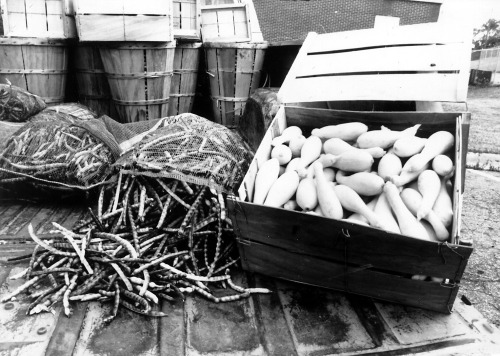
- At Miss-Lou Farmers Co-op, operating in the four southwest
Mississippi counties and two Louisiana parishes, the co-op had sales of cucumbers and peppers in 1970 of $63,425. This was a 176% increase over the 1969 crop of $23,000. Over the past four seasons of its existence, the co-op
has consistently fought for higher prices for its members. For the period from 1967-1971, the co-op raised the price per hundred pounds paid to the farmers for cucumbers by $0.95 or 35.6% in comparison to its competitor’s prices. On an average yield of 7,000 lbs. per acre, this is an increase of $66.50 per acre to
growers. On peppers, the co-op has caused the price to increase from 6.5¢ in 1969 to 8.5¢ in 1971, an increase of 23.4% over the past three years. This year as a result of [the Federation’s] membership training sessions, members in two communities purchased their own cucumber grading machines to increase their flexibility and advantage in marketing.
These brief glimpses into the operations of such modest cooperative enterprises demonstrate the power of the Federation’s involvement. By providing training, advice on marketing, crop selection, and cooperative governance, the Federation was able to smooth out some of the rough patches that each cooperative had experienced and help move the co-ops for the first time to profitability. It is also apparent that by combining the output of various individual farms (as in the Sea Island and Miss-Lou examples), the local co-op was able to force the price point for the products to a higher level, putting
more money into the individual farmers’ pockets while also generating a margin
for the cooperative.
The Federation also played a critical role in advising co-ops on just how the cooperative enterprise was supposed to work: the role of the Board of Directors in the setting of policy; the role of the co-op manager in day-to-day operations; the importance of the one-member/one-vote democratic governance structure. Federation staff also served as sounding boards for inevitable disagreements that would arise about these finer points of cooperative operations.
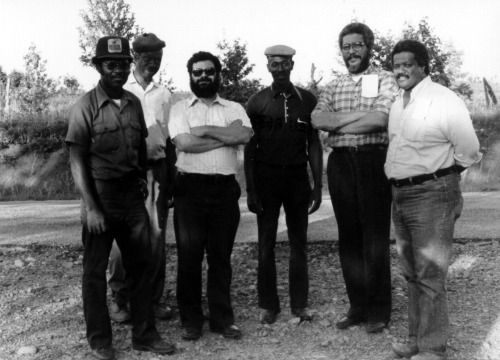
Charles Prejean (second from right), along with Federation staff members John Zippert (sunglasses) and Ralph Paige (right) visit with local farmers to discuss their needs.
By 1971, the Federation was receiving praise from important boosters. At its annual meeting that year, the American Institute for Cooperatives hosted CLUSA’s recently retired president and former U.S. Congressman Jerry Voorhis, who honored the Federation for “doing a job of outstanding importance” for the rural poor. Also that year, the Field Foundation’s Dunbar wrote Prejean to say that “all of us at Field are greatly impressed by what the Federation has accomplished.”
It is instructive to note that of the 110 members in 1971, 25 of them were credit unions with a combined asset total of more than half a million dollars. That year, more than 2,500 loans had been made to their low-income members. This was micro-lending before the term had been coined, and it is a testament to both McKnight’s and Prejean’s vision that they had the foresight to understand that even small loans could make a big difference in the lives of low-income people with limited access to traditional funding sources.
Unfortunately, even in 1971, Prejean expressed concern over the unfriendly views that the credit union regulatory body, the National Credit Union Administration (NCUA) had toward small, low-yield credit unions with volunteer staff like the ones the Federation was helping to create and sustain. “The Federation has developed with (its) member credit unions a critique of the present discriminatory policies of the NCUA toward low-income organizations,” Prejean wrote. This issue would haunt the Federation’s credit union members for years, causing some to merge and others to shutter their doors.