
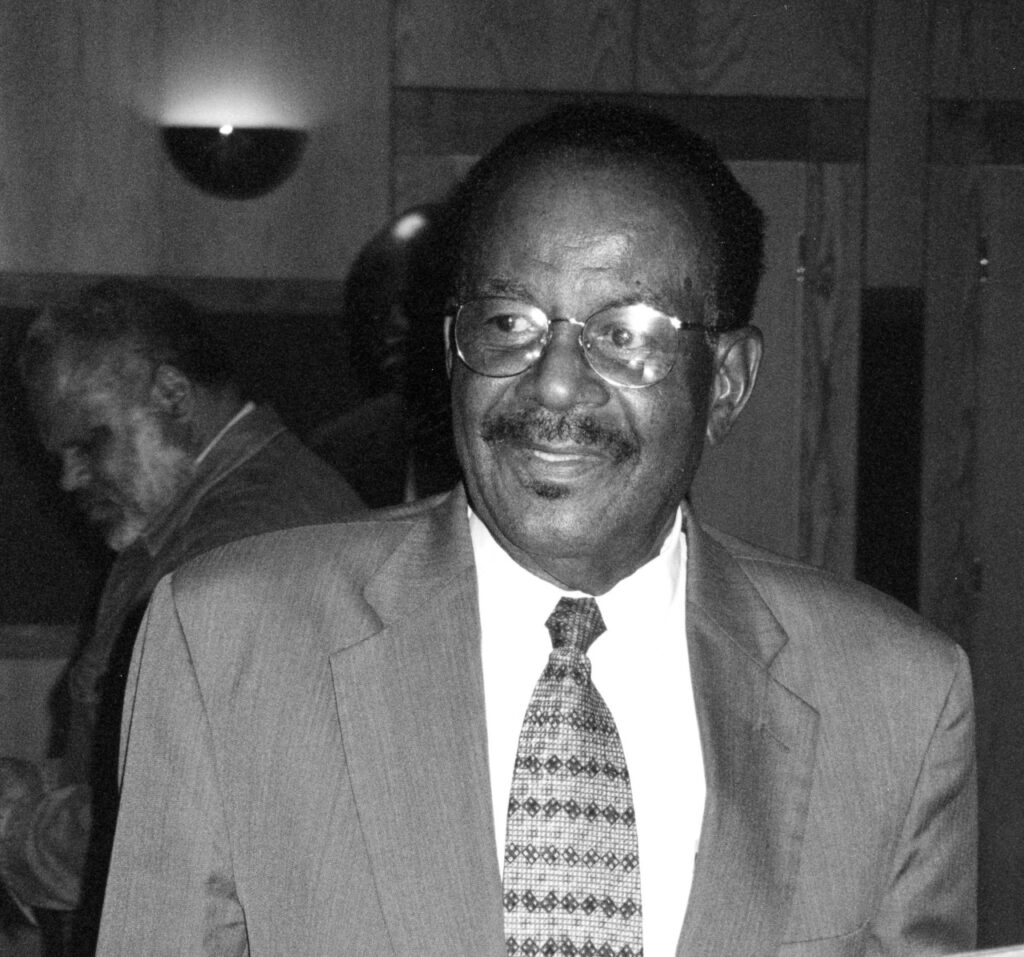
Here’s the story I promised months ago (contributed by veteran civil and land rights activist John Zippert) … about the Panola Land Buying Association. With many more news outlets picking up on the travesty of Black Land
Loss (See last month’s story in The New Yorker, The Washington Post and next month’s Atlantic Monthly), it’s important to note the wins along the way. Here’s the eighth in my series on the Federation of Southern Cooperatives, which has been fighting for Black farmers and their land for more than 50 years.
________________________
The Panola Land Buying Association (PLBA) in Alabama arose out of the civil rights and
economic and social justice struggles of the 1960’s. The members of PLBA worked
as tenant farmers, raising cotton, on three large plantations in north Sumter
County, Alabama, near the town of Panola.
The members of PLBA joined Rev. Fred Shuttlesworth’s Alabama Christian Movement for Human Rights and were part of its Sumter County affiliate. Shuttlesworth was a fearless civil rights preacher from Birmingham who called Dr. King to join him to fight Bull Conner in the 1963.

The Reverend Fred Shuttlesworth, whose Alabama Christian Movement for Human Rights inspired farmers in Sumter County to band together into the Panola Land Buying Association.
The tenant farmers, moved to action by the Civil Rights Movement, tried to register to vote in Sumter County. They also sued the three plantation owners for their share of the government price support payments on cotton. The tenants won their lawsuit in 1966, in part because one of the plantation owners, John Rogers, was also the chair of the Sumter County Agricultural Stabilization and Conversation Service (ASCS) Committee. The role of the local county ASCS committee was to
determine crop allotments, crop yields and payments of subsidies when acreage
allotments were reduced.
The ASCS regulations, promulgated by the USDA, provided that tenants and sharecroppers were to receive their proportionate share of acreage divergence payments and other government subsidies. At the local county level these rules were not implemented fairly. The tenants won a small settlement from the lawsuit, although most say the plantation owners took the money back and applied it to debts.
After the cotton was harvested in 1966, the plantation owners sent eviction notices to all 100 tenants on the three plantations, saying that they would have to move and seek a new livelihood because the owners were switching from cotton to cattle and raising pine trees on their land. Privately the plantation owners were heard to say they were tired of “uppity Negro,” although they didn’t
exactly use those words. There were many other places across the South during this time where Black sharecroppers and tenants fighting for justice were evicted and had to find new places to live and work.
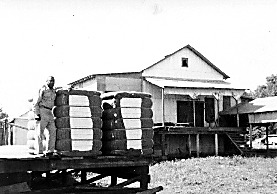
Cotton bales ready for market.
Some of the one-hundred families moved to Chicago, some moved to Tuskegee and forty
families remained behind in Sumter County, living with relatives, looking for land to farm, houses to live in and alternative employment if farm land could not be found. These families formed the Panola Land Buying Association.
Three community organizers, affiliated with the Southern Cooperative Development Program and the Federation—Lewis Black from Greensboro, Albert Turner from Marion, and Thelma Craig from Lisman—began meeting with the PLBA member families to determine what they wanted to do. The families expressed their desire to purchase some land to farm and homes for their
families to live in comfortably. They met in a small community store owned by Lewis and Tessie Thomas, in the Warsaw community that was part way between Panola and Gainesville. (Tessie Thomas, was later elected Constable in 1968, one of the first Black elected officials in Sumter County.)
Lewis Black found a white merchant, P. M. Norwood, in Gainesville who had just lost
three tracts of land, totaling 1164 acres, in a foreclosure. At that time, the owner of foreclosed land had up to two years to redeem their land for the price of the foreclosure, plus legal fees and interest. Black persuaded Norwood to enter an agreement with the PLBA to redeem his land and sell two of the three
tracts to PLBA.
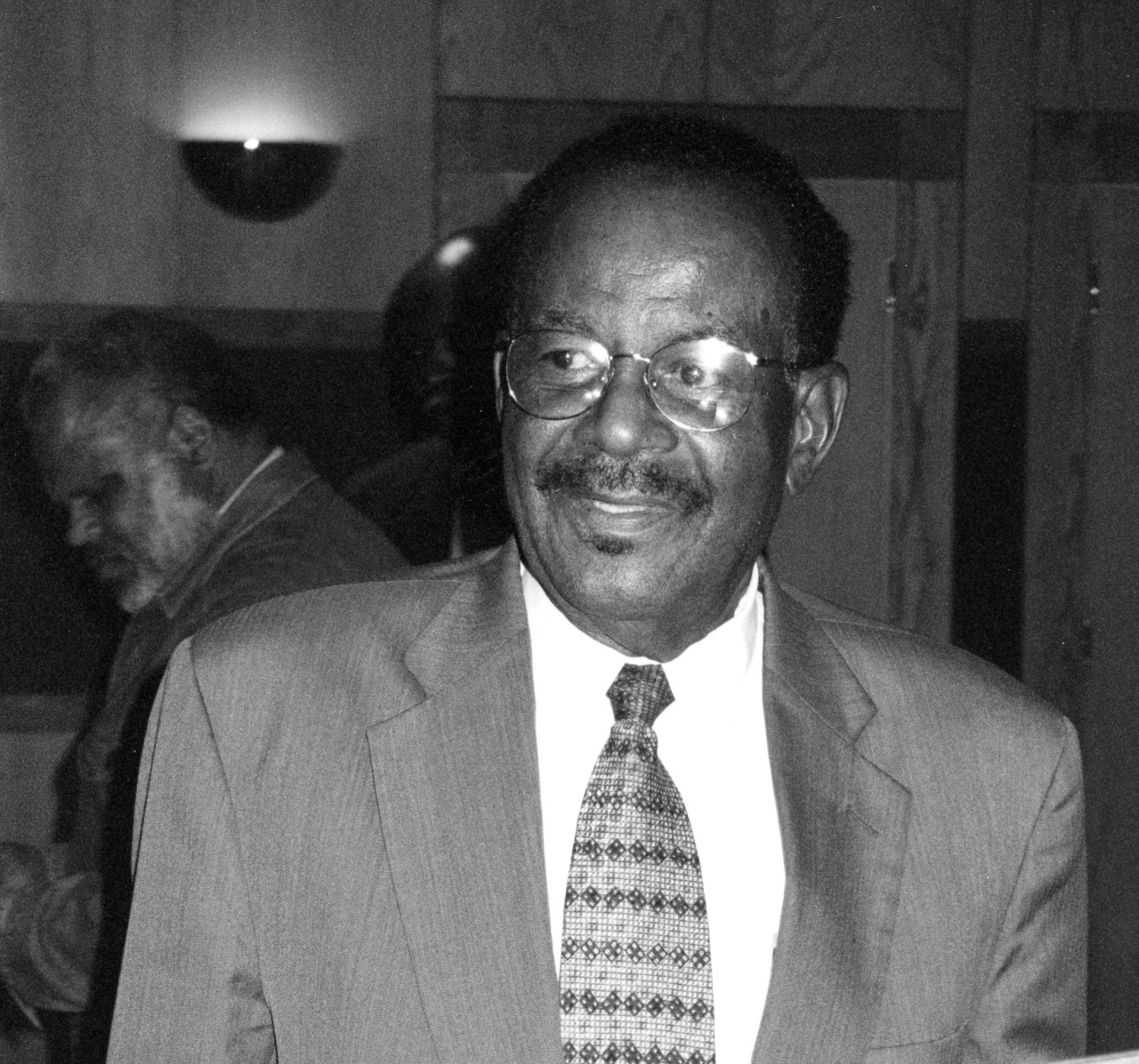
Lucius Black (pictured) and his twin brother Lewis were champions of the economic justice and cooperative movements in Alabama. Lucius served on the Federation’s board of directors and Lewis was an original incorporator and served on the Federation’s staff. It was Lewis Black whose tireless work with the Panola Land Buying Associaiton managed to secure the land on which the Federation’s Rural Training Center now stands.
It took three more years and battles in local and Federal courts for PLBA to be able to excise its redemption rights to the land. By this time, Norwood had decided to withdraw from the transaction for a fee. In September 1970, the PLBA was awarded the land by the Federal District Court in Birmingham. The Federation and Father McKnight worked together to finance this transaction with four mortgages. The first mortgage was held by the League Life Insurance Company, a credit union-owned company in Detroit, Michigan.
At this point, the Federation, which was looking for a site to locate a co-op training center, came together with PLBA to reach an agreement. The Federation agreed to assist PLBA to pay for all of the land in exchange for title to 1,374 acres, where the Federation’s Rural Training Center was built.
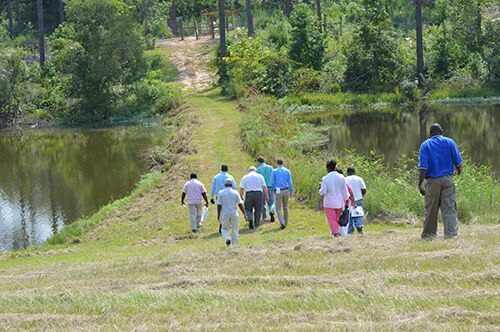
Members visit the Federation’s Rural Training Center located on more than 1,300 acres of land acquired while helping the Panola Land Buying Association in its efforts to gain access to land for Black farmers.
The Federation continued to assist the Panola Land Buying Association to farm and develop their community-held land. The Wendy Hills subdivision of forty units of USDA/FmHA Multi-family Rural Rental Housing was built starting in 1978, after another protracted struggle with local agents of the state and Federal government.
As we celebrate our 50th anniversary, we are proud to say that between the Federation and the PLBA we still own every single acre of the original 1,164 acres, which was the basis of an on-going and enduring struggle.