• Biography
  • Books
  • Excerpts
  • Blog
  • Reviews
  • Media
  • Events
  • Contact
+321 123 4567
info@test.com
My Account

Jackson, Mississippi – 50 Years Later

Posted on June 1, 2013
No Comments

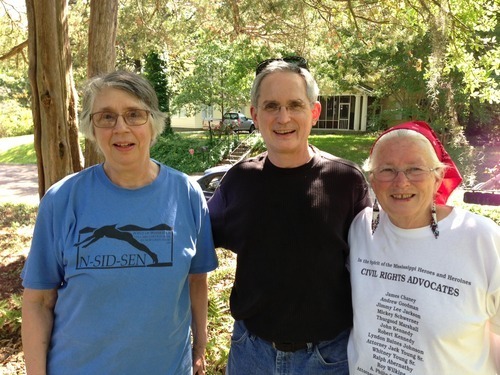
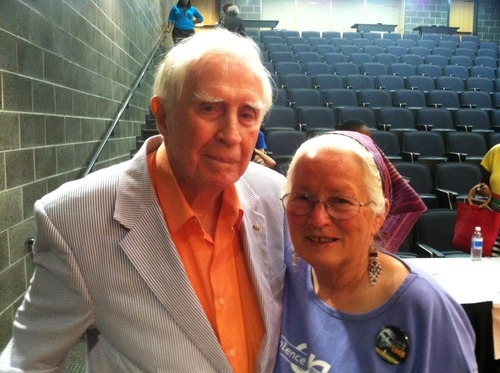
I traveled with Joan Trumpauer Mulholland this week to Jackson, Mississippi , to participate in the  commemoration of the 50th anniversary of the Jackson Woolworth’s sit-in.  We had quite the celebration.

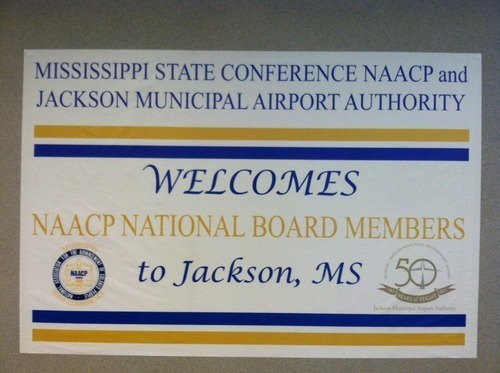
First, when we arrived on Memorial Day (May 27) at the airport, a sign greeted us that was hard to fathom: Mississippi State Conference NAACP and Jackson Municipal Airport Authority WELCOMES NAACP National Board Members to Jackson, MS. For the NAACP to be welcomed in Mississippi speaks to the tremendous changes in race relations that have occurred here during the past half century.  That was our first pleasant surprise.
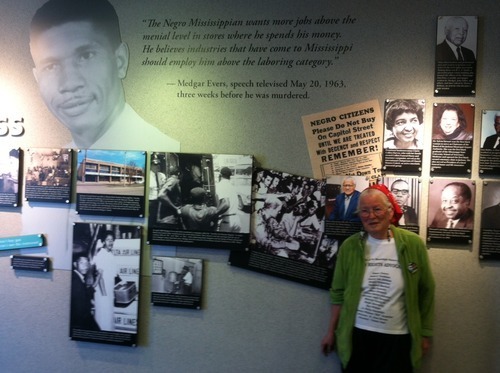
  We next went to visit the Medgar Evers Memorial Pavilion—a separate wing right in the center of the airport, where the sit-in photo is housed with a bust of Medgar and various other commemorations of his service to the city and state.

The “faithful” began to gather that afternoon–those who had some connection to the sit-in. Lois Chaffee, one of Joan’s partners at the sit-in, arrived soon after we did.

We stayed at the Hilton Garden Inn (formerly the King Edward Hotel) on Capitol Street—the same street where the Jackson Movement demonstrations occurred. The hotel stands at the bottom of Capitol Street, just across from the train station—the very station that Joan entered and was arrested in as a Freedom Rider in June of 1961.

As we walked up the street to the Elite Restaurant for breakfast on Tuesday, May 28, the local paper, The Clarion Ledger announced in a four-column headline: Woolworth’s Sit-In >> 50th Anniversary; SITTING DOWN, THEY TOOK A STAND.  The famous Fred Blackwell photograph of the sit-in filled the rest of the page above the fold and a two-paged story by AP reporter Emily Wagster Pettus accompanied the photo. (I was honored that Emily mentioned my book, WE SHALL NOT BE MOVED, and quoted extensively from the Foreword by Julian Bond.)

 http://www.clarionledger.com/viewart/20130528/NEWS01/305280018/Sitting-down-they-took-stand-Miss-remembers-Woolworth-s-sit-anniversary

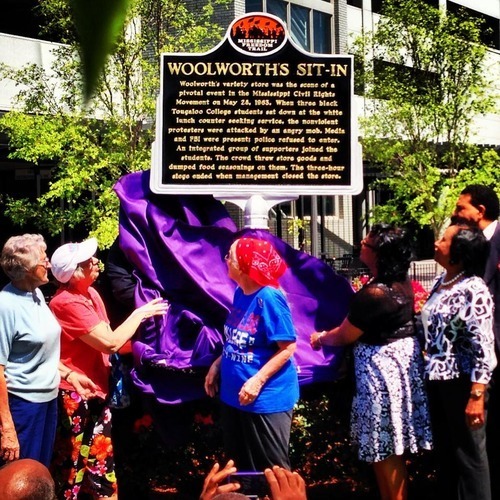
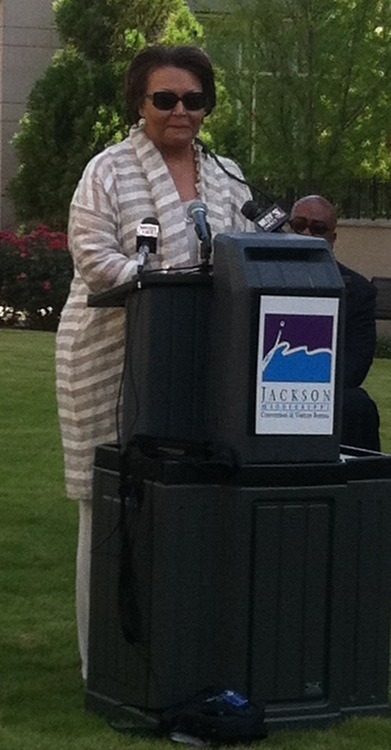
That was just the beginning. Directly across from the Elite, a crowd had gathered for the unveiling of an historical marker on the site of the Woolworth’s. Although the building was torn down long ago, a welcoming park invites visitors to sit and reflect on how much has changed in Jackson during the past 50 years. A ceremony honoring those who had taken this “stand” for freedom commenced at 10 a.m. Various public officials—both black and white—made  strong statements about the heroes of the Jackson Woolworth’s sit-in. One even reminded us that Memorial Day is not only for veterans of foreign wars, but for all those who stood up for freedom, even those on our own shores.

The mayor of Jackson was on hand to celebrate the day, unlike 50 years ago when then-mayor Allen Thompson was holed up at City Hall determined to defeat the demonstrators and return Jackson to an antiquated and unequal way of life. This mayor, Harvey Johnson, Jr., is Jackson’s first black mayor.  My how things have changed.

 Ed King, the former Tougaloo College Chaplain, who had witnessed the entire sit-in from his spot in the back of the store half a century ago, provided the invocation on this glorious day. He cited Psalm 1 and Psalm 62 from which the wonderful gospel spiritual and later civil rights anthem WE SHALL NOT BE MOVED is derived:  “Just like a tree, planted by the water, we shall not be moved.”

Three individuals were on hand to represent those who sat in. Verna Polk spoke eloquently about her brother, George Raymond and his role in the sit-in as well as his commitment to the Mississippi movement. Alphonzo Lewis remembered his sister Pearlena’s role in the sit-in by telling the story of how she returned home after enduring the three-hour ordeal covered in catsup and mustard, yet heartened by the stand she had taken. Then Joan spoke, remembering those in the press who also suffered through the antics of the out-of-control mob while attempting to cover the story. She then turned her remarks to those who helped plan and execute the demonstration and ended with the plea: “Above all, remember Medgar.”

The families of the demonstrators then proceeded over to the marker and pulled the purple covering down, unveiling Marker #12 of Mississippi’s Freedom Trail.

I had always imagined some sort of commemorative representation on this site. (I had hoped for a full-blown sculpture—maybe someday.) This was quite a milestone in the journey of getting this iconic event memorialized for the ages.

I was pleased to see Fred Blackwell in the crowd of nearly 100 who had gathered to mark the occasion. Fred was a photographer for The Jackson Daily News in 1963 and took most of the photos that have come to be associated with this galvanizing event, which led to two weeks of nearly daily demonstrations on Capitol Street.

Tougaloo College then hosted a luncheon for the families of the participants. Many people spoke about how the sit-in and the brave Tougaloo College students who participated were an inspiration for future generations of activists. Tougaloo College President Beverly Hogan commented that the work of activism is never done and called upon current and future students to find their own causes and forums for changing the world.

Legendary Mississippi journalist Bill Minor was on hand and remembered coming upon Joan Trumpauer at an event honoring him almost 20 years ago. He was the first to win the John Chancellor Award for Excellence in Journalism from the Annenberg Public Policy Center at the University of Pennsylvania. At the awards ceremony, held in Washington, DC in May 1997, Minor was overcome with emotion when he spotted Joan in the crowd. “She’s the real hero,” he told the assembled dignitaries, including Ethel Kennedy, the wife of slain politician Robert Kennedy, as well as many journalists who had covered the civil rights movement.  Minor, now 91, is still writing his column and keeping his “Eyes of Mississippi.” (He told me he’s reading “WE SHALL NOT BE MOVED and is impressed with the amount of research it took to pull it all together.)

That evening, the film “An Ordinary Hero” was shown at the Student Center at Jackson State University. Many viewers were moved to tears as they learned about the civil rights career of Joan Trumpauer. Her son, Loki, was on hand to talk about the film that he wrote, directed and produced to honor his mother.

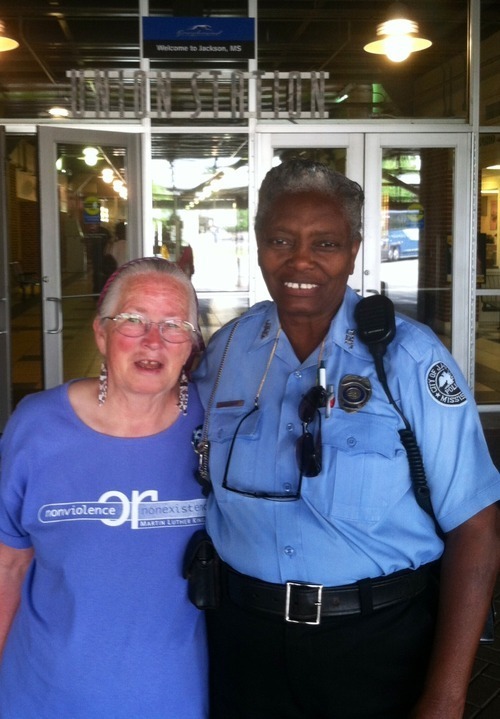
Next day, we made a visit to  the train station, the place where Joan first touched Mississippi ground. Here we were greeted, incredibly, by Jackson’s best and most vivacious public servant, Rubye Mickel of the Jackson City Police. How fitting that a black female police officer—and a congenial one at that—should provide Joan with a walking tour of the newly renovated train and bus station on Capitol Street.  Rubye has great pride in her city and great hopes for the future, which she shared with us. Her enthusiasm knew no bounds (she had seen Joan’s picture the day before and was excited to see her in person) and she was a delightful presence whose positive energy continues to linger. I may have been one of the few to recognize the distance Jackson has come. One of the concessions the Jackson Movement was able to capture from the mayor 50 years ago was the hiring of black policemen and crossing guards. Rubye is a glowing testament to the Jackson Movement’s gains.

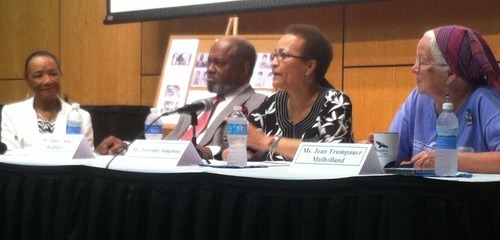
 Next day, Joan participated in a panel discussion on the campus of Tougaloo College with two other 1960s activists, Euvester Simpson and Sam Bradford. The program was held at the new Bennie Thompson Academic and Civil Rights Research Center and moderated by Tougaloo’s Dr. Delores Bolden Stamps.

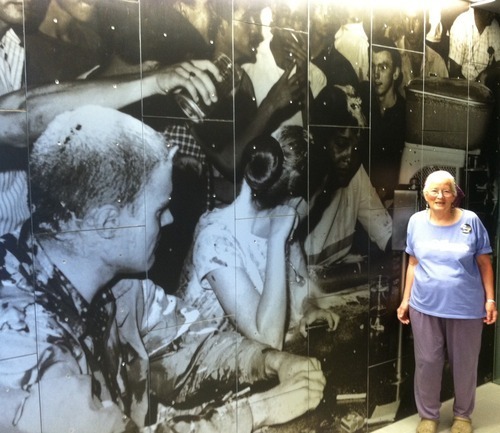
Floor-to-ceiling representations of some of Tougaloo’s storied activist past grace the building, including the iconic Jackson Woolworth’s sit-in photo. Fitting that Joan’s civil rights career should come full circle with a larger-than-life representation of where she made her most famous stand.

Post Views: 15
Previous Post
The TV Speech that Rocked Mississippi
Next Post
Discover M.J. O’Brien’s Powerful Chronicles of Civil Rights Activism

Leave a Reply Cancel reply

Your email address will not be published. Required fields are marked *

Fill out this field
Fill out this field
Please enter a valid email address.
You need to agree with the terms to proceed

Recent Posts

  • The Tougaloo Nine: Where the Jackson Movement Began July 6, 2026
  • Discover M.J. O’Brien’s Powerful Chronicles of Civil Rights Activism July 6, 2026
  • Jackson, Mississippi – 50 Years Later June 1, 2013
  • The TV Speech that Rocked Mississippi May 27, 2013
  • Revolutions Sometimes Start with Small Steps May 15, 2013

Categories

  • Mississippi (2)
  • NAACP (2)
  • The Tougaloo Nine (1)
  • We Shall Not Be Moved (3)
  • Website (1)

It was while visiting the Martin Luther King Center for Social Change in Atlanta, Georgia in 1991 that M. J. O’Brien conceived the work that has become We Shall Not Be Moved. As part of its civil rights display, the King Center showed a photograph of the 1963 Jackson, Mississippi Woolworth’s sit-in—a photograph that has become the image used in history books and magazine articles to show what a sit-in was like. O’Brien was captivated by the photograph because at its center was a woman, Joan (Trumpauer) Mulholland, whom he had known for a number of years.

Read more

We Shall Not Be Moved is a labor of love. Primarily created in the late 1990s and finally brought to life through the auspices of the University Press of Mississippi, it is a story of triumph and determination that was captured by the now-iconic Fred Blackwell photograph. Although its publication was delayed (as told in Acknowledgements), timing is everything. The book was supposed to be published in 1999, but for a variety of reasons, it is only reaching a broader public today. And that is as it should be. We are on the cusp of celebrating the 50th anniversary of the Jackson Woolworth’s Sit-In (May 28, 1963) and the courageous souls who decided, one-by-one , to sit in at the counter that day are being recognized for their contribution to the overall civil rights struggle.

Read more

It was while visiting the Martin Luther King Center for Social Change in Atlanta, Georgia in 1991 that M. J. O’Brien conceived the work that has become We Shall Not Be Moved. As part of its civil rights display, the King Center showed a photograph of the 1963 Jackson, Mississippi Woolworth’s sit-in—a photograph that has become the image used in history books and magazine articles to show what a sit-in was like. O’Brien was captivated by the photograph because at its center was a woman, Joan (Trumpauer) Mulholland, whom he had known for a number of years.

Read more

We Shall Not Be Moved is a labor of love. Primarily created in the late 1990s and finally brought to life through the auspices of the University Press of Mississippi, it is a story of triumph and determination that was captured by the now-iconic Fred Blackwell photograph. Although its publication was delayed (as told in Acknowledgements), timing is everything. The book was supposed to be published in 1999, but for a variety of reasons, it is only reaching a broader public today. And that is as it should be. We are on the cusp of celebrating the 50th anniversary of the Jackson Woolworth’s Sit-In (May 28, 1963) and the courageous souls who decided, one-by-one , to sit in at the counter that day are being recognized for their contribution to the overall civil rights struggle.

Read more

Photos

  • Biography
  • Books
  • Excerpts
  • Blog
  • Reviews
  • Media
  • Events
  • Contact

FOLLOW US

Facebook
Twitter
  • Biography
  • Books
  • Excerpts
  • Blog
  • Reviews
  • Media
  • Events
  • Contact

FOLLOW US

Facebook
Twitter

Copyright © 2026 Not Be Moved. All rights reserved. Design by McBorrough Webdesign

Copyright © 2026 Not Be Moved. All rights reserved. Design by McBorrough Webdesign

  • Biography
  • Books
  • Excerpts
  • Blog
  • Reviews
  • Media
  • Events
  • Contact