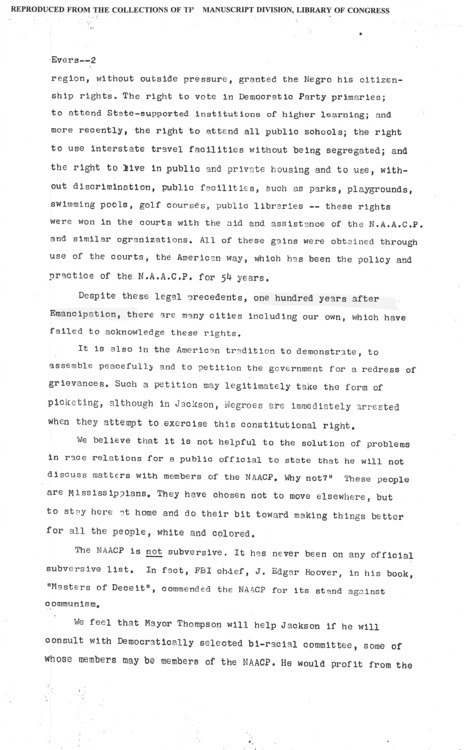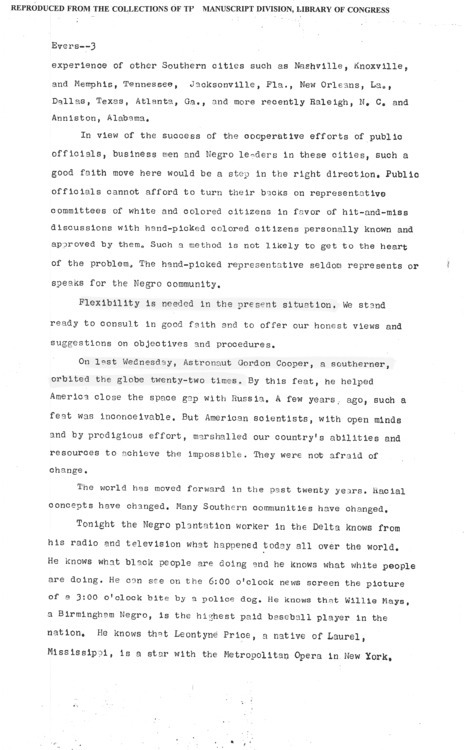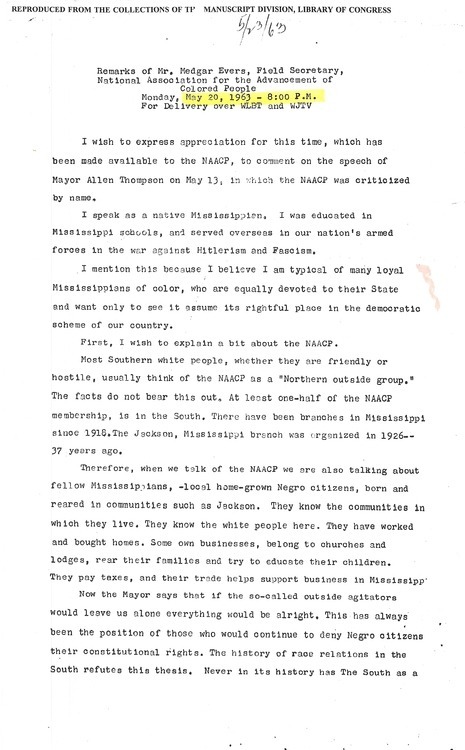
Fifty years ago this week, Medgar Evers went on TV and delivered a well-reasoned, dispassionate speech about why Mississippi needed to change its segregated practices and become more inclusive and more just. What is remarkable about his presentation is that it happened at all. In May of 1963, whites were not used to seeing blacks on TV, particularly not local blacks with something to say about the apartheid practices of Mississippi. The way this came about was a bit of a fluke.
In my previous post (Revolutions Sometimes Start with Small Steps), I told the story of how Jackson’s mayor, Allen Thompson, went on the airwaves to denounce the NAACP’s announcement that it would begin backing street demonstrations if the mayor refused to negotiate with the black leadership over eight basic demands:
· – Desegregation of all public facilities, including parks, playgrounds and libraries
· – Eventual desegregation of the schools
· – Removal of segregation signs from all public places
· – Desegregation of lunchrooms and lunch counters in downtown stores
· – Hiring blacks on the police force
· – Upgrading the salaries of black municipal workers
– Employment of black crossing guards
– Formation of a biracial committee to continue working to improve race relations in the city.
Today, we might view these demands as laughable, too little, obvious. But 50 years ago, these were nothing short of revolutionary.
In his speech, Mayor Thompson made the mistake of mentioning the NAACP and denouncing their tactics. This allowed for an opening. At Evers’s suggestion, the national NAACP petitioned the Federal Communications Commission for an opportunity to rebut the mayor’s assertions under the Fairness Doctrine. The FCC granted this request and on Monday, May 20, 1963, Medgar Evers had the chance in prime time to make the case for the more equitable treatment of blacks throughout Mississippi. He took that chance, made the case, and in the process caused such a stir that at least one Mississippian vowed to kill him.
Here are the first few pages of that seven-paged presentation by Evers. The full speech now resides at the Library of Congress in their NAACP collection.