
• Biography
  • Books
  • Excerpts
  • Blog
  • Reviews
  • Media
  • Events
  • Contact
+321 123 4567
info@test.com
My Account

Revolutions Sometimes Start with Small Steps

Posted on May 15, 2013
No Comments

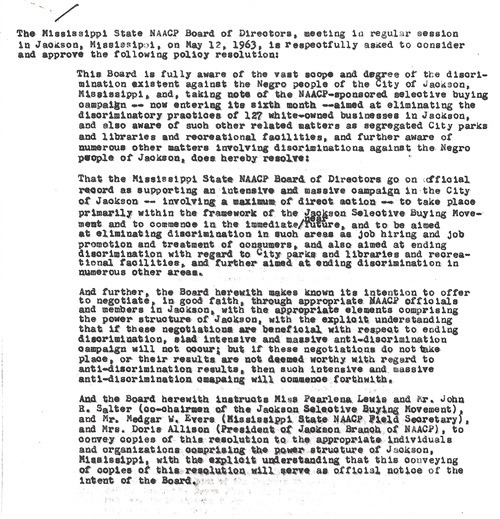
Revolutions sometimes start with small steps. The resolution passed by the NAACP Mississippi state board of directors on May 12, 1963, was one such small step.  It had been a tense negotiation within the NAACP board meeting in Jackson. Tempers had flared.  National NAACP representatives questioned the efficacy of such an in-your-face statement. But in the end, the state board passed this resolution (after modest changes), perhaps not fully realizing the extent to which Jackson would be thrown into turmoil by its determined authors. 

Those authors were John Salter, advisor to the NAACP North Jackson Youth Council, who had fomented for change since his arrival in Mississippi in August of 1961; Medgar Evers, who was seeking ways to energize the black populace of Jackson after more than eight years of spirit-breaking resistance to an unrelentingly brutal and unyielding racist system; Pearlena Lewis, 22-year old President of the North Jackson Youth Council; and, Doris Allison, president of the Jackson branch of the NAACP.  These four would form the core, the backbone of the Jackson Movement as it slowly ratcheted up pressure for change on the Mayor and the city’s power structure.

This resolution, released in the form of a letter to long-time Jackson Mayor Allen Thompson, to the Chamber of Commerce, and to other power institutions within the city, so unnerved the mayor that he took to the airwaves the next day to denounce it and to reassure Jackson’s citizens that “any agitator who comes to this city will be prosecuted without any exception whatsoever.” Thompson pleaded with Jackson’s “Nigra” citizens: “Refuse to pay any attention to any of these agitators” and particularly targeted the NAACP for attempting to stir up trouble.

Like so many public relations disasters, Thompson’s mistake was reacting. In doing so, and in mentioning the NAACP, he opened up an opportunity for the NAACP—and Evers as its local spokesperson—to seek equal airtime. The FCC granted exactly that, and on May 21, Evers, on primetime television, debunked the mayor’s phony assessment of harmonious race relations and demanded change or else. The showdown would cost Evers his life—an incalculable loss—but it would also rally black Jackson to begin to demand more from their leaders, both black and white. Gradually change began to occur.

Revolutions sometimes start with small steps. Let us honor those courageous NAACP board members and the leaders of the Jackson Movement for their small, momentous  steps forward 50 years ago this week. WE SHALL NOT BE MOVED ….

Post Views: 60
Previous Post
Thinking About Memphis Norman Today …
Next Post
The TV Speech that Rocked Mississippi

Leave a Reply Cancel reply

Your email address will not be published. Required fields are marked *

Fill out this field
Fill out this field
Please enter a valid email address.
You need to agree with the terms to proceed

Recent Posts

  • The Tougaloo Nine: Where the Jackson Movement Began July 6, 2026
  • Discover M.J. O’Brien’s Powerful Chronicles of Civil Rights Activism July 6, 2026
  • Jackson, Mississippi – 50 Years Later June 1, 2013
  • The TV Speech that Rocked Mississippi May 27, 2013
  • Revolutions Sometimes Start with Small Steps May 15, 2013

Categories

  • Mississippi (2)
  • NAACP (2)
  • The Tougaloo Nine (1)
  • We Shall Not Be Moved (3)
  • Website (1)

It was while visiting the Martin Luther King Center for Social Change in Atlanta, Georgia in 1991 that M. J. O’Brien conceived the work that has become We Shall Not Be Moved. As part of its civil rights display, the King Center showed a photograph of the 1963 Jackson, Mississippi Woolworth’s sit-in—a photograph that has become the image used in history books and magazine articles to show what a sit-in was like. O’Brien was captivated by the photograph because at its center was a woman, Joan (Trumpauer) Mulholland, whom he had known for a number of years.

Read more

We Shall Not Be Moved is a labor of love. Primarily created in the late 1990s and finally brought to life through the auspices of the University Press of Mississippi, it is a story of triumph and determination that was captured by the now-iconic Fred Blackwell photograph. Although its publication was delayed (as told in Acknowledgements), timing is everything. The book was supposed to be published in 1999, but for a variety of reasons, it is only reaching a broader public today. And that is as it should be. We are on the cusp of celebrating the 50th anniversary of the Jackson Woolworth’s Sit-In (May 28, 1963) and the courageous souls who decided, one-by-one , to sit in at the counter that day are being recognized for their contribution to the overall civil rights struggle.

Read more

It was while visiting the Martin Luther King Center for Social Change in Atlanta, Georgia in 1991 that M. J. O’Brien conceived the work that has become We Shall Not Be Moved. As part of its civil rights display, the King Center showed a photograph of the 1963 Jackson, Mississippi Woolworth’s sit-in—a photograph that has become the image used in history books and magazine articles to show what a sit-in was like. O’Brien was captivated by the photograph because at its center was a woman, Joan (Trumpauer) Mulholland, whom he had known for a number of years.

Read more

We Shall Not Be Moved is a labor of love. Primarily created in the late 1990s and finally brought to life through the auspices of the University Press of Mississippi, it is a story of triumph and determination that was captured by the now-iconic Fred Blackwell photograph. Although its publication was delayed (as told in Acknowledgements), timing is everything. The book was supposed to be published in 1999, but for a variety of reasons, it is only reaching a broader public today. And that is as it should be. We are on the cusp of celebrating the 50th anniversary of the Jackson Woolworth’s Sit-In (May 28, 1963) and the courageous souls who decided, one-by-one , to sit in at the counter that day are being recognized for their contribution to the overall civil rights struggle.

Read more

Photos

  • Biography
  • Books
  • Excerpts
  • Blog
  • Reviews
  • Media
  • Events
  • Contact

FOLLOW US

Facebook
Twitter
  • Biography
  • Books
  • Excerpts
  • Blog
  • Reviews
  • Media
  • Events
  • Contact

FOLLOW US

Facebook
Twitter

Copyright © 2026 Not Be Moved. All rights reserved. Design by McBorrough Webdesign

Copyright © 2026 Not Be Moved. All rights reserved. Design by McBorrough Webdesign

  • Biography
  • Books
  • Excerpts
  • Blog
  • Reviews
  • Media
  • Events
  • Contact