
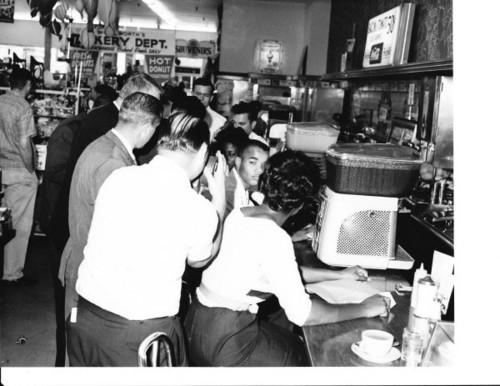
As we enter this month of memories—the 50th anniversary of the rise of the Jackson Movement—I’m thinking of some of the heroes of that time, what they accomplished with their lives, and where they are now.
I thought of Memphis because I visited the National Museum of American History yesterday. As I entered from the Mall, I was immediately swept into a demonstration of what it was like to be part of a sit-in. Daily, now, an actor or actress engages the crowd of vacationers and visitors to imagine what it would have been like to have suffered the blows of an angry mob while attempting to sit nonviolently and not strike back.
What is remarkable about this demonstration is that it takes place in front of a piece of the actual Woolworth’s counter from Greensboro, North Carolina, where the first attention-getting sit-in took place on February 1, 1960. It is certainly a striking display and a welcome attempt to educate a populace that is quickly forgetting the heroism of yet another “greatest generation.”
Memphis was a reluctant part of that generation. Born into extreme rural poverty, he commented on how his family was looked down upon even by those others with whom they shared their sad lot. “Those Normans!” others used to say derisively. Those Normans didn’t even have shoes to put on their children’s feet when they went to the run down shack of a black school that they attended. Those Normans could barely keep food on the table. Those Normans, as dysfunctional as any American family of the period, carried the shame of a hopelessly alcoholic father and a sainted mother who kept the family fed and clothed.
Memphis was smarter than the average poor black child and his teachers begged his parents to let him stay in school instead of joining his brothers in the field for the fall harvest or the spring planting on their sharecropped fields. The parents complied with these wishes, and Memphis was free to pursue his dreams of becoming a successful public servant and helping his family out of poverty. He entered Tougaloo College, just outside of Jackson, Mississippi, after his junior year of high school thanks to a United Negro College Fund program that helped advanced students get into college early to help avoid a perilously high drop-out rate for black males.
At Tougaloo, Memphis Norman flourished, particularly under the tutelage of Dr. Ernst Borinski, a Jewish refugee from the Holocaust who decided to teach at Tougaloo because he understood that America’s race problem was similar to what he had just escaped and wanted to be part of the solution. Memphis became Bobo’s assistant, answering his mail and inviting prominent speakers to attend the monthly Social Science Forum where blacks and whites could visit, share a meal, and listen to intriguing presentations by top minds.
Memphis was true to his word throughout college. He stayed focused. He didn’t let anything get in the way of his studies. He shied away from civil rights activists, whom he saw as “wild-eyed radicals” who never studied and had a hard time passing their course work. Close to the end of his junior year at Tougaloo, however, he was asked by one of those “radicals” to join him for a demonstration. It was a sit-in at the downtown Woolworth’s. “Classes are over for the year, “ she told him, “and instant arrest is expected. You’ll be back on campus by dinner time.”
Memphis felt a bit guilty that he hadn’t done anything to advance the cause earlier, particularly since he was working for such a progressive mentor as Dr. Borinski. So he agreed to participate, and that decision changed his life.
On May 28, 1963, Memphis entered the Woolworth’s on Capitol Street in downtown Jackson and took a stand by sitting down. He wasn’t arrested immediately. The police stayed outside because a recent U.S. Supreme Court decision had ruled that the sit-ins were legal and could not be interfered with. This was unexpected. So instead of instant arrest, after an hour, Memphis was knocked off his stool by a local thug—a former Jackson City police officer—who had no patience for agitators. Memphis fell, unconscious, from his stool to the linoleum-covered cement floor. When he came to, he was being kicked and stomped by his assailant. Instead of responding in kind, he curled up into a ball as best he could to protect himself and let the stomper continue his horrible attack. By the time an undercover cop moved in to stop the madness, Memphis was bleeding from his nose, his mouth and his ear. He was helped up by the law officer and then promptly arrested for disturbing the peace—an interesting turn of events for someone who had been sitting peacefully for an hour and then lying on the floor refusing to fight back. He was, if anything, keeping the peace. It was with some satisfaction that Memphis discovered that his white assailant was also arrested, for assault.
Three days later, the charge against Memphis was dropped, while that of his assailant was pressed and he was judged guilty—an unusual occurrence at this point in Mississippi’s judicial history. A black man getting off and a white man found guilty for assaulting a black. Something was changing in the Magnolia State.
Memphis suffered no serious harm as a result of his injuries that day. He did, however, complain of pain in his right temple—the place he was first sucker-punched in the head—for the rest of his life. But what a life it was. Memphis Norman, at Dr. Borinski’s insistence, went on to earn a master’s degree in public administration from the University of Pittsburgh, was drafted into the Army and fought for two years in VietNam, and then landed at the Office of Management and Budget when he returned, working there for 28 years. He became a senior budget officer and oversaw the finances of such storied institutions as the National Aeronautics and Space Administration (NASA), the Smithsonian Institution, the Kennedy Center, and the National Gallery of Art.
And here’s where it gets even more interesting. While on my visit yesterday to the American History Museum—after my sit-in experience at the entrance—I was ushered in to see “The Star Spangled Banner,” the flag that flew over Fort McHenry while the British attacked the port of Baltimore during the War of 1812. I was reminded of a meeting that Memphis had arranged for me with the heads of the museum back in 1998. That was when I had been doing my original research for We Shall Not Be Moved and we had grand plans to partner with the museum and their sit-in exhibit (at the time they were showing photos of both the Greensboro and the Jackson Woolworth’s sit-ins side-by-side). We were ushered in to meet with Spencer Crew, the museum’s director, and Lonnie Bunch,assistant director and the man who had orchestrated the donation of the Greensboro counter to the museum. After about an hour of talking about the Jackson sit-in and Memphis’s role in it, the discussion turned to budgets. It seems that there was a dual purpose for this meeting—one I was unaware of until the players moved the agenda forward.
Messrs. Crew and Bunch wanted to talk budgets because they were concerned that “The Star Spangled Banner” was deteriorating. At the time it was displayed on the museum’s second floor upright and available to the daylight that came in through the large doors at the entrance of the museum. They knew that this extremely valuable relic of American history would be lost if something wasn’t done—something important and costly—and they wanted to broach the subject with Memphis, who was responsible for pulling the museum’s budget together.
It was fascinating to watch how these three black men, all of whom had suffered the scourge of American racism during their early lives, were fretting over a powerful American symbol of freedom, democracy, and, yes, defiance in the face of near-impossible odds. They themselves symbolized the new America that had emerged from the old as a result of much suffering and difficult choices on the part of some, including Memphis Norman. This trio of leaders came to some agreement that day that moved the ball forward and I must say, Memphis Norman, you would be proud of the results.
The new display of our nation’s “Star Spangled Banner”, the actual flag that inspired our national anthem, is itself awe-inspiring. The flag is now fully protected from the light and from damage from vertical hanging. It is, instead, draped across a huge slanted support system and lit by light sources that will no longer damage or fade the material. And the information visitors absorb on their way into the display and upon exiting is simple, clear, and uplifting. I was overwhelmed at the beauty and simplicity of their work—and all those who labored to preserve this unique American treasure.
Spencer Crew is now the Robinson Professor of U.S. History at George Mason University, after more than 30 years spent curating exhibits and managing the day-to-day operations at the American History Musuem as well as those at the National Underground Railroad Freedom Center in Cincinnati. Lonnie Bunch is now serving as the founding director of the National Museum of African American History and Culture, which is under development on the Mall and will open in 2015. And Memphis Norman, sadly, died in his sleep unexpectedly in 2005 after a life filled with firsts in service to our country.
I’ve been thinking of Memphis Norman today … with good reason. .. and am sad he will not be sharing these two amazing feats with us: the 50th anniversary of the Jackson Woolworth’s Sit-In and the beautifully rendered new display of a national relic. I am so honored to have had the opportunity to capture this gentle man’s memories before he passed. You can read more about Memphis and his remarkable life in We Shall Not Be Moved: The Jackson Woolworth’s Sit-In and the Movement It Inspired.