
Eighth in a Series on the Federation of Southern Cooperatives
During the Federation’s 50th Anniversary year, marvel at its broad sweep and bold initiatives during its early days. Another installment from the Federation’s 50th Anniversary Commemorative Booklet: “50 Years of Courage, Cooperation, Commitment & Community.”
Funds for Families as well as for Co-ops
It was clear to the early cooperative boosters that the best way to help impoverished farmers was to give them access to capital to help smooth out the cyclical nature of their businesses and to grow their small operations. The credit union movement—a cooperative-like structure—offered the perfect antidote to individuals who had no credit history, could not get loans from White-owned banks, and who actually needed very little to make a go of their start-up businesses or to buy feed or seed for their family farms. “If a community is experiencing common problems with little resources,” Charles Prejean explained, “it made so much sense to pool resources and use them to satisfy a common need.”
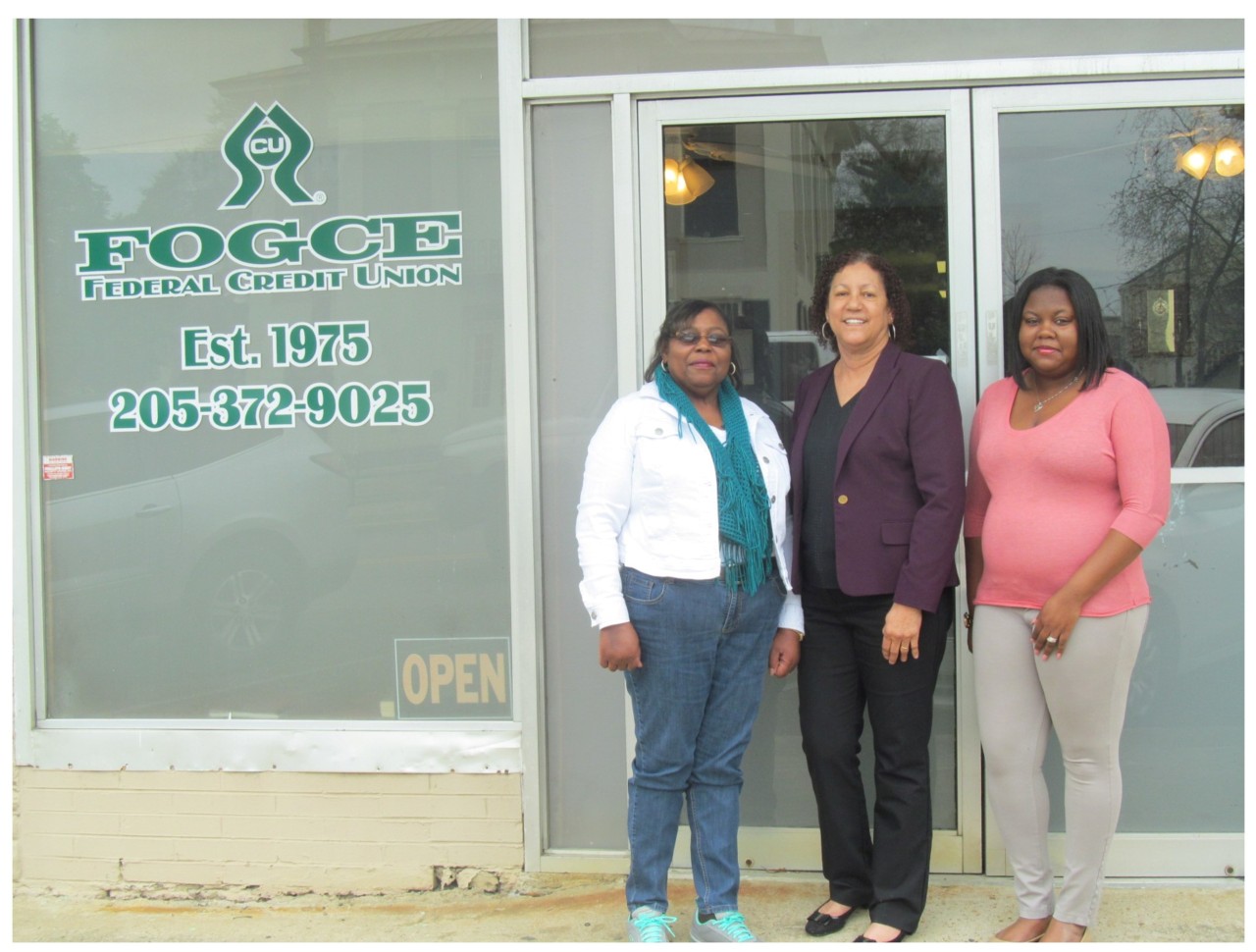
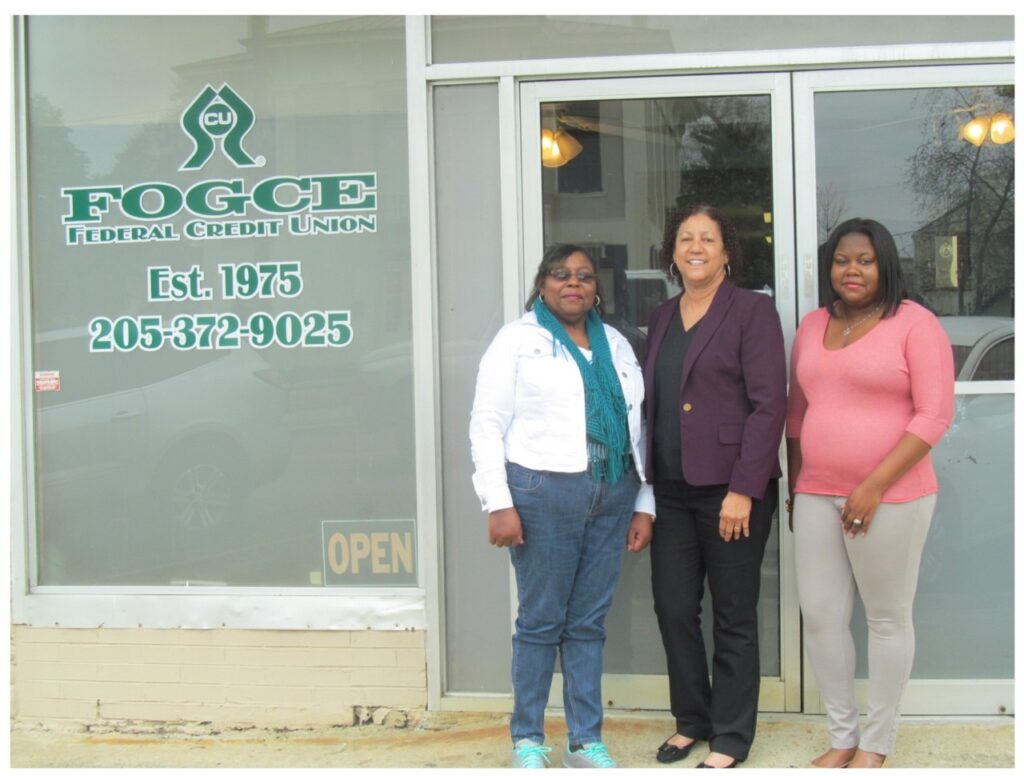
Friends of Greene County Employees Credit Union–one of the many credit unions fostered by the Federation over the years. Pictured are Carol Prejean Zippert, President (center) flanked by Joyce Pham, Manager (left) and Kierra Epps, Accounting Clerk.
Representatives from several credit unions were present at the Federation’s formation. Once the organization was up and running, creating community-based credit unions became a key focus of the staff. One of the Federation’s early hires was Earnest Johnson, a self-taught financial wiz whose entire professional career would be spent helping low-income Southern farmers create and sustain credit unions so that they could have access to capital when they needed it. “For us to build on the civil rights movement,” Johnson once said, “we had to own businesses and we had to provide decent jobs for people.” The only way to do that was by pooling resources and building equity. Johnson worked tirelessly during his more than 30 years with the Federation to help struggling credit unions for low-income rural people to avoid the pitfalls of many such start-up entities: poor lending and collection practices, careless record keeping, inexperienced board members, and untrained management and lending staffers. Johnson became the Federation’s ambassador to its member credit unions, dispensing advice and offering his expertise to the 25 or so credit unions that have been under the Federation’s umbrella over the years.
Sadly, despite Johnson’s untiring efforts, the NCUA’s stringent requirements for size and capital investment forced many of the Federation’s member credit unions during the past 20 years either to merge with larger ones (most of which were not Federation members) or to liquidate altogether. Today, only six credit unions remain as part of the Federation’s family of cooperative institutions. Cooperative economics expert Dr. Jessica Gordon Nembhard notes, “The NCUA’s lack of understanding of the importance of these grassroots financial institutions to the Black community limits the ability of the [Federation] to provide support and asset-building opportunities to its members.” The Federation continues to advocate for less onerous requirements for locally based credit unions in order to help its member cooperatives provide the kind of capital lending base that their members require to succeed.
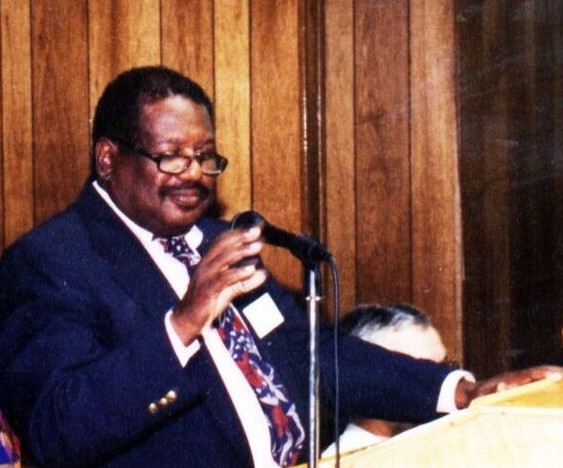
Ernest Johnson addresses credit issues at one of the Federation’s Annual Meetings at its Training Center, Epes, Alabama. Johnson was a pioneer in bringing credit union services to the poor of the South.
Cooperative Health Care and Housing
The number of times the Federation referred to its work as a “movement”—not only in the early days, but throughout its fifty years—is instructive.
Co-ops have become a vanguard and foundation for an economic base for Black people in the rural South. The Co-op Movement has successfully conveyed the idea and ideology that poor and oppressed people can find a way to work out of their problems by working together through the Federation. 1972 Annual Report
The survival of our member co-ops, the continued existence and growth of our Federation and the entire Cooperative Movement are testimony to our resilience and belief in working together collectively to cause and create the changes that are necessary. 1974 Annual Report
As we meet to celebrate the 14thAnnual Meeting of the Federation of Southern Cooperatives, there is much for us to be thankful for to God and [to] each other in the cooperative movement. 1981 Annual Report
Building on the work of the Civil Rights Movement, the Federation has organized a community-based cooperative economic development movement among 25,000 low-income families working in over 100 communities in the rural South. 1993 Annual Report
We have completed another year of success and struggle to develop a meaningful cooperative movementto serve African-American farmers and other low-income people and communities across the Southeast. 2010 Annual Report
Those working for the low-income rural poor saw what they were doing was not just creating better jobs or better prices for their members and their products. Cooperatives were bringing an entirely new spirit to the once-depressed and demoralized citizens of the rural South, providing them a way to work together to gain a share of the American Dream. The vision was not simply economic in nature, though that was a large part of it. The vision was one of uplift, of hope, of self-determination, of working together for the common good. As evidence of this, some of the early visionaries expanded their initial scope of enhanced capital access and agricultural and handicraft cooperatives to encompass an array of democratically run institutions that could attend to all of the basic needs of the members and the community, including affordable health care and decent, well-built housing.
Not surprisingly, many of these innovations occurred in the proximity of the Federation’s home base—in the counties surrounding the Epes Training Center in Alabama. The Federation staff and their families provided the leaven for all sorts of innovative cooperative ideas for rural development and community progress. The Federation first stretched into these endeavors in the early 1970s with the advent of a housing project conceived on some of the land purchased with the PLBA. It took years of advocating for funding from the federal government and fighting with local building permitting agencies, but in 1980, the Wendy Hills Housing Project was launched (named after Wendell Paris, the first occupant of the Epes Training Center land), with 40 new homes for needy residents. Additional Federation-supported housing projects have yielded funding for more than 700 new or refurbished housing units for members primarily in Alabama.
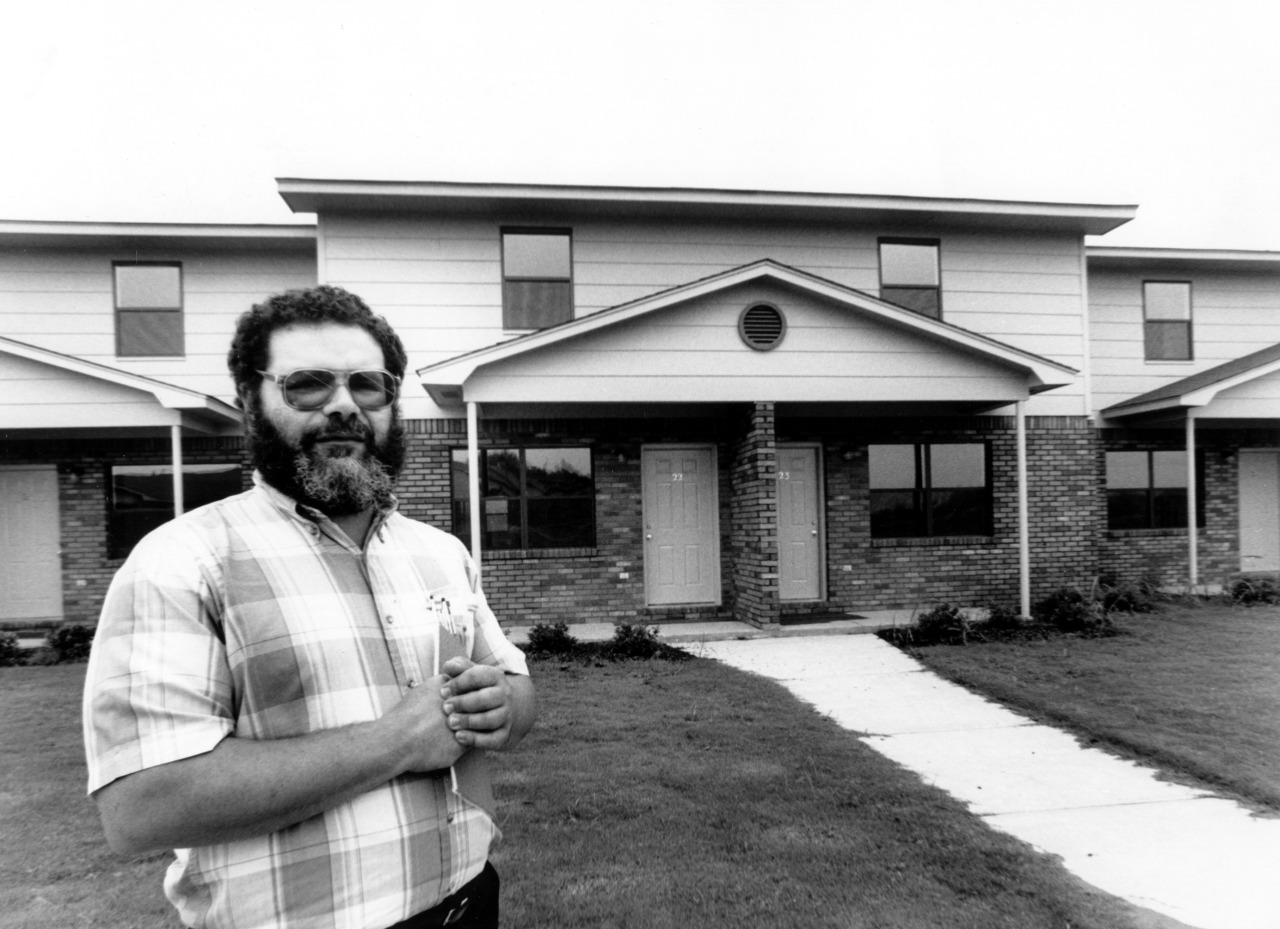
Federation staffer John Zippert stands in front of an affordable housing apartment complex, the Sanders-Black apartments in Eutaw, Alabama, built by the Federation.
It cannot be underestimated the impact that these modest homes had on the local populace, many of whom had lived for much of their lives in tenant farmer shacks with no indoor plumbing or electricity. Access to these amenities was a huge advance, both in terms of quality of life and improved health. Additionally, to the degree possible, the Federation ensured that those who built the homes were people indigenous to the area, and that those knowledgeable about construction techniques passed along that knowledge to younger trainees who participated in jobs training programs funded by federal government grants.
Health care was another matter altogether. It is a truism that rural areas typically suffer from lack of adequate medical care and that residents often have to travel to urban centers for anything more than the treatment of the common cold. From its earliest days, the Federation’s leadership had envisioned the creation of family health care centers to provide basic health and dental care to rural residents in “medical scarcity areas” within the Federation’s geographic footprint. With the opening of the Training Center at Epes, the possibility for creating a start-up health care initiative became a possibility.
By 1972, the Federation had received funds from the U.S. Department of Health, Education, and Welfare (HEW) and other agencies to plan for the creation of a health care demonstration project to be run out of the Training Center. Should the program prove effective and successful, it could serve as a model for other such centers throughout the South and, indeed, throughout the country.
Out of this start-up concept came the Black Belt Family Health Care Center. As with so many of the Federation’s initiatives, its indigenous health care program ran into local White resistance and was forced eventually to merge with the White-controlled West Alabama Health Services. A promising concept of self-help cooperative health care was aborted to serve the interests of local elites rather than those most in need of its services. The concept remains a potential game-changer for providing health care services to underserved rural communities.