
Dorothy Day and her Hope-filled “Revolution of the Heart”
What a time we’re in! I’ve put my blog on hold while working
on my next book, but feel the need to come back with a few pieces to “Keep Hope
Alive” in these dark times. And just in time for a Dorothy Day revival! Dorothy Day, the enterprising journalist and
social activist (and perhaps soon to be saint of the Catholic Church) is having
something of a revival of her reputation. A new biography (Dorothy Day
by John Loughery and Blythe Randolph) and a new documentary (“Revolution of
the Heart: The Dorothy Day Story” by Martin Doblmeier) have put Day back in
the limelight where she belongs. She’s recently appeared in the New York Times
Book Review (written by prominent religion historian Karen Armstrong, no less), for an extensive New Yorker
profile, and even today in the REVIEW section of the Wall Street Journal! Day’s
renaissance couldn’t come at a better time, when, thanks to the pandemic, the
fragility of our safety net for the poor shows itself for what it really is:
benign neglect, if not downright abuse.
I’ve been an admirer of Dorothy Day’s for decades, dating
back to my time as a Catholic seminarian in Baltimore in the 1970s when we were
encouraged to think a lot about the poor and about social conditions and how
best to put our social consciences to work to improve things. After leaving the
seminary and trying to find my way throughout the rest of the ‘70s, I enrolled
in The American University’s School of Communications and set about trying to
improve my skills as a writer. While pursuing a second bachelor’s degree in
Communications (the first, from St. Mary’s Seminary College, was in
Philosophy), I happened upon a wonderful journalist/teacher Joe Tinkelman, who
taught some of my earliest writing classes and whose consistent encouragement
caused me to believe I might have a career as a writer someday.
For his “American Newspapers” class, Tinkelman pushed us to
write a long-form journalistic piece profiling a newspaper of our choice. My
mind immediately went to The Catholic Worker, Dorothy
Day’s creation from the 1930s that was still going strong in the 1980s. I
thought a 50-year retrospective was in order, so I set about to research this
little-known gem and report back to Tinkelman and the class. The research I did
(mostly at Catholic University) put me in deeper touch with Dorothy Day, her
philosophy, her writing, and her work with the poor of New York City.
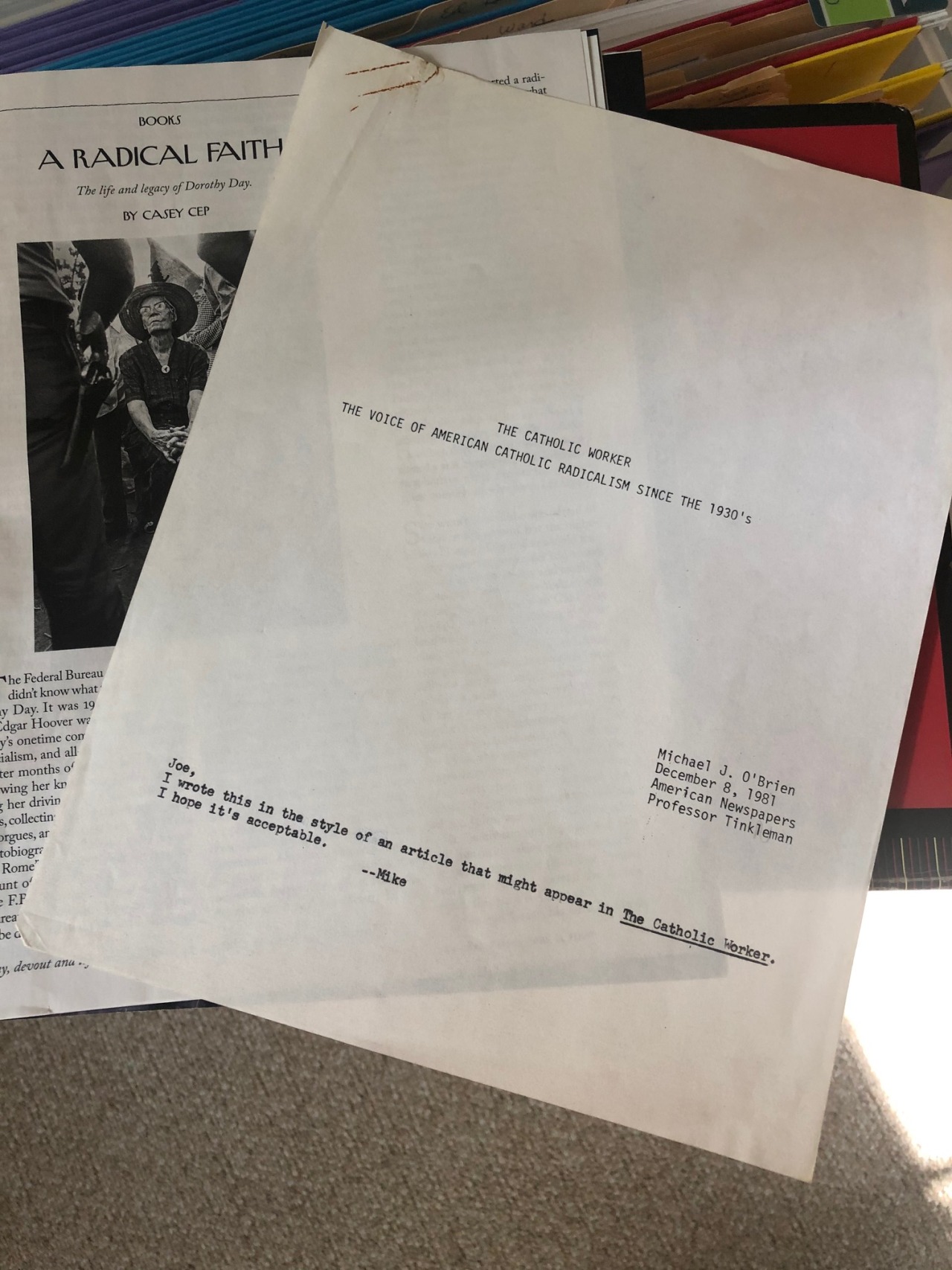
For the next four weeks, I’m posting a serialized version of
the paper I did for Professor Tinkelman as a tribute to his inspiring teaching
and to Dorothy Day herself and her incredible work. Read with caution: You may
just get radicalized!
* * * * * * * * * * * * * * * * * * * * * * ** * * * * * * * * * * * * * * * * * * * * * * * * * *
The Catholic Worker—The Voice of American Catholic Radicalism Since
the 1930’s (Part I)
By Michael J. O’Brien, 12/8/81 – American Newspapers, American
University, Professor Joe Tinkelman
On a piercingly cold night in December of 1978, I stepped from the
sub-compact I had so comfortably been traveling in with a former seminarian
classmate of mine onto the curb of Second Avenue on the Lower East Side of
Manhattan. We were on our way to Maryhouse, the Catholic Worker’s House of
Hospitality for homeless women, to attend one of the C.W.’s Friday night
meetings. It was my first visit to the Catholic Worker Headquarters. Before I
could even close the car door, a middle-aged Black man with the smell of
whiskey on his breath and of urine on his clothes—the smell of the destitute in
any city—asked me for some money “for a cup of coffee.” I remember looking into
this man’s half-dazed eyes, seeing behind him the lights of Second Avenue—the
bars and novelty shops, the cafes and movie houses that give the street a
feeling of one continuous cabaret—and wondering how to tell him on this of all
nights that I could not give him a penny.
[Part of our seminary training was to decline to give money to
alcoholics. “They’ll only use if to further their illness,” we were told.]
I was already late for the C.W. meeting, so instead of inviting him for
a bite to eat at one of those cafes, I asked him to join me at Maryhouse. I
knew he would at least be warm there and perhaps could even get a cup of hot
coffee. He refused, and as my friend and I dashed across the street to get to
the meeting, I heard him cursing us. I can’t think, now, of a more appropriate
greeting for my first visit to the Catholic Worker—a group that has served the
poor and the dispossessed of the Bowery for almost 50 years.
At the time, however, I was only thinking of our lateness! As we opened
the doors to Maryhouse and rushed up the stairs of this seemingly ancient
tenement, I was awed by the thought that Dorothy Day, co-founder of the
Catholic Worker—“both a newspaper and a movement”—graced these steps daily. For
all I knew, she was there that very night, this being her primary residence in
the City. I didn’t know much about Dorothy Day then, but I knew she had chosen
to live her life among the poor and to serve them as if they were Christ. That
was enough to spark my interest in her and in her work.
My friend and I entered the doors of the auditorium to a standing-room
only crowd. More than two hundred people were packed into this tiny hall that
serves as a distribution center for the newspaper and the meeting hall for “the
clarification of thought,” as Peter Maurin, the Catholic Worker’s other
founder, put it.
We took our places among those standing in the back and I caught a
glimpse of Daniel Berrigan, the radical Jesuit pacifist, who was speaking to
the throng. Berrigan was scheduled to talk that night—I guess that’s why so
many people showed up—on the poetry of Thomas Merton, a well-known Catholic
monk and author who died in the late 1960s. Berrigan read to us some of
Merton’s poems concerning war, peace, death, and nuclear armaments. After each
poem, he gave us his own interpretation of what he believed Merton was trying
to convey; they had been good friends.
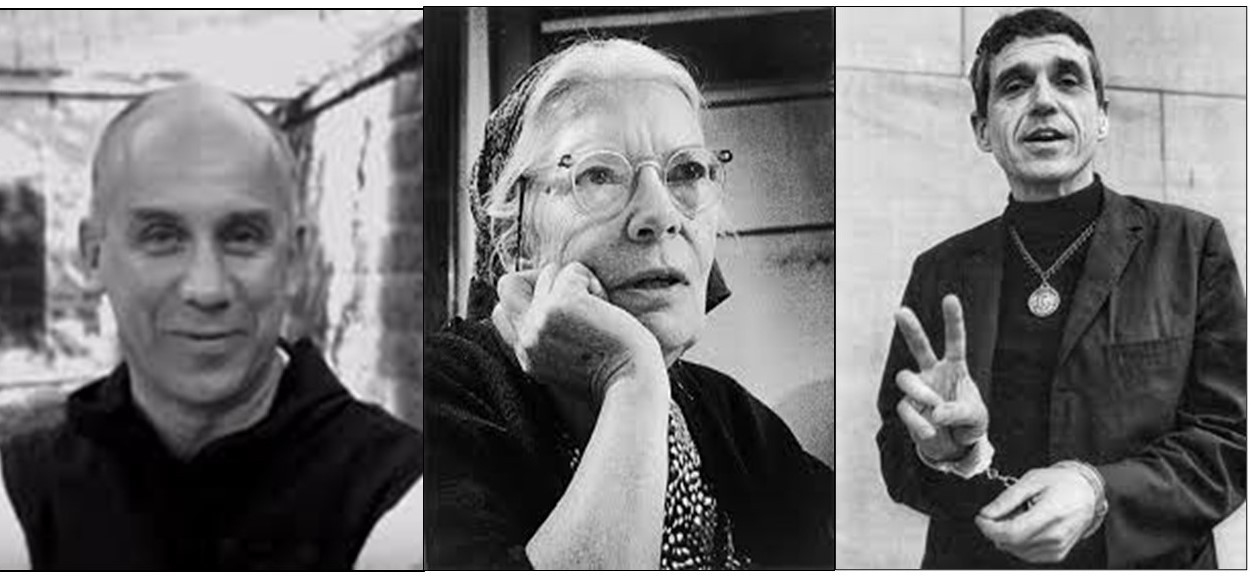
Thomas Merton, Dorothy Day, and Daniel Berrigan: Three pillars of radical Catholic thought in the 1960s.
The entire evening had an aura of unreality about it for me. Here I was
in Dorothy Day’s house listening to Daniel Berrigan speaking on Thomas
Merton—three pillars of radical Catholic thought represented under one roof!
The history of modern Catholic radicalism came alive for me that night. It is some of that history, particularly the Catholic Worker’s singular role in its development, that
I will attempt to relate in the text that follows.
The Young Radical Journalist
One could say Dorothy Day was a journalist from birth. Her father was a
sports writer for the New York Morning Telegraph; her brothers became
newspaper editors. Journalism was in her blood.
She became involved in questions of social justice at an early age. She
read Upton Sinclair’s The
Jungle and Jack London’s essay on class struggle while still in
high school. One of her brothers worked on a Chicago paper (where the family
lived during Day’s adolescence) called The Day Book, an
experiment by Scripps-Howard that reported on the ups and downs of the Labor Movement.
The paper’s accounts of the the struggles of the poor and of the workers
stirred Dorothy deeply. She began to feel that her life was linked to theirs,
that she had received “a call, a vocation, a direction” for her life.
Dorothy Day began her career as a journalist in 1916 at the age of 18
by taking a job at a newspaper coincidentally named The New York Call—a
socialist daily that was heavily involved in the labor issues of the day. Later
she worked on The Masses, a monthly Communist magazine. After
the periodical’s suppression by the Attorney General during the post-World War
II “Red Scare”, Day worked for The Liberator, the
successor to The Masses.
Her assignments took her to all kinds of strike meetings, picket lines,
and peace rallies. She interviewed Leon Trotsky while he was living in New York
and writing for a Russian socialist newspaper. She picketed the White House and
went to jail for a month with a group of suffragists. She counted as her
friends Eugene O’Neill, the great American playwright; Max Eastman, editor of The
Masses; and John Reed, author of Ten Days That Shook the
World, a journalists’s account of the Russian Revolution. (The new
movie REDS explores aspects of the lives of all three of
these men.)
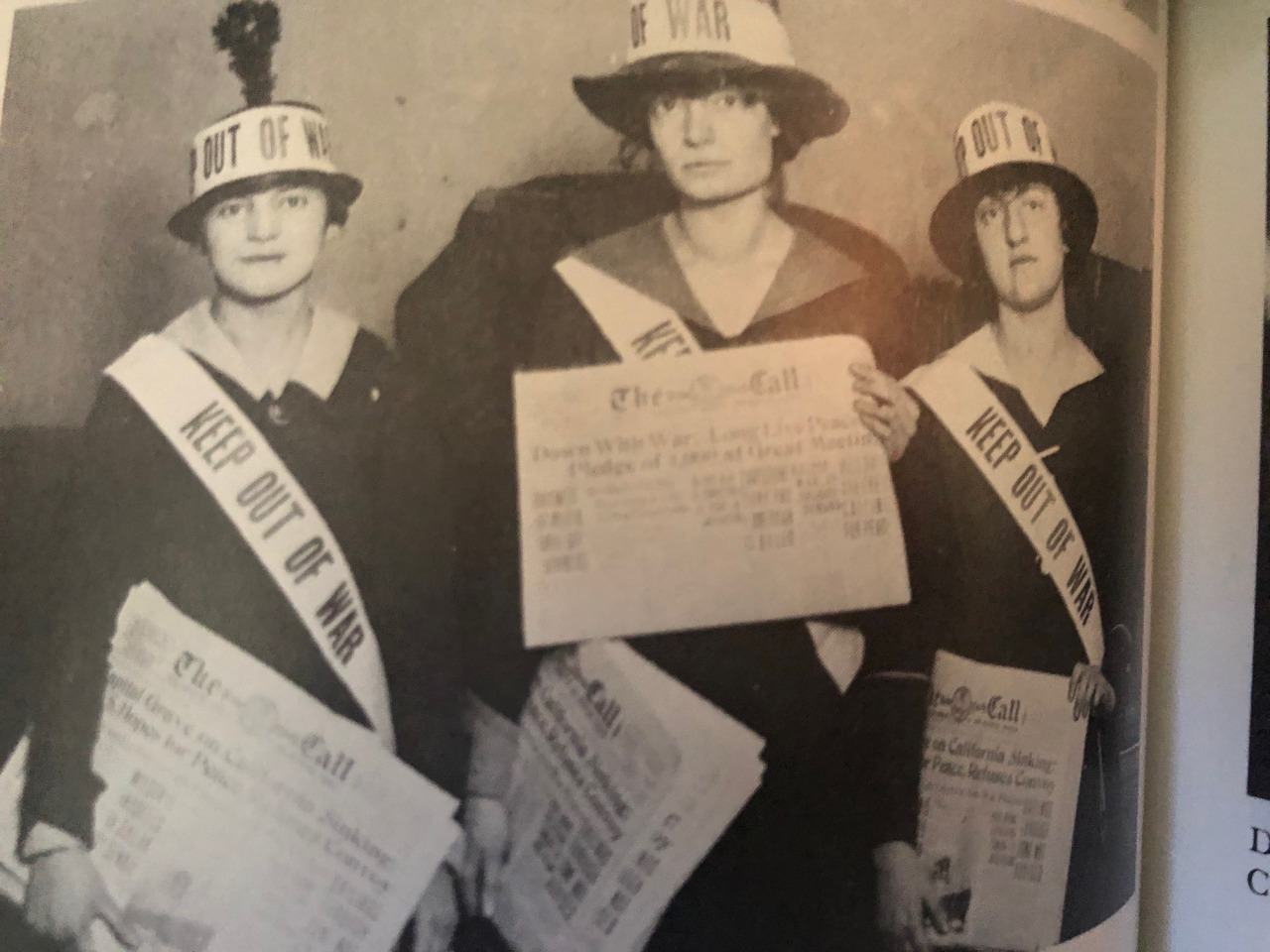
A 1917 photo of Dorothy Day (center, holding a copy of The New York Call) urging the U.S. NOT to enter WWI.
An Unlikely Convert
Although her early years as a journalist were spent advocating for causes
and movements that were considered godless (Communism, after all, considers
religion as an opiate), Dorothy Day converted to Catholicism in 1927 at the age
of 30. She saw the Catholic Church as the church of the poor and of the worker,
and she wanted to be one with them in every way. Also, she had given birth to a
little girl through a common-law marriage, and the overwhelming love she
experienced for both her lover and her daughter made her believe that there
must be a God.
Day’s conversion caused her much suffering; she had to leave the man
she loved because he would not condone her religious leanings. But she put
principle before personal comfort, as she would so many times in the future.
After her Baptism, Day found she was no longer one with her comrades.
They could not understand her religious convictions and she found it difficult
as a Catholic to participate in demonstrations and meetings that were organized
by Communists. She continued to report on the plight of the working man for
Catholic periodicals—she even did a series of articles for the Catholic press
explaining Marxist-Leninism!—but she felt far removed from her earlier radical
involvement. She was at a loss as to how to reconcile her two great loves—her
newfound love for God and her continued love for the working man and the poor.
An Answered Prayer
Dorothy Day often warned people to be careful how they prayed. “God
takes you at your word,” she would say. It was through just such a prayer that she found
a solution to her dilemma and that The Catholic Worker
came to be.
In early December 1932, Day was covering a march on Washington, D.C.,
by the Communist-led Unemployment Councils. The march was an attempt by the
Depression’s unemployed workers to bring their grievances to Congress. Day was
reporting on the march for two Catholic periodicals, Americaand Commonweal. She became distressed by the
march’s lack of Catholic leadership and felt she could no longer sit by and
watch as others, especially Communists, took the lead in fighting for the
working man. She had to find a way to get involved in the
struggle as a Catholic.
On December 8, just after the worker’s march and, coincidentally a
Catholic Holy Day, Dorothy Day went to the Shrine of the Immaculate
Conception—still under construction in Washington—and prayed fervently that God
would show her the way out of the box she was in. Remarkably, God took her at
her word. When she returned home to New York, Peter Maurin, the man who was to
teach her the way out, was waiting for her in her apartment.
Peter Maurin
Maurin had been sent to Day by the editor of Commonweal
because they “thought alike.” He was a French peasant and was deeply rooted in
Catholic social tradition. He had studied Aquinas, Augustine, and the socialy
encyclicals of the Popes, as well as the many contemporary Catholic social
writers, including Hillaire Belloc, Emmanuel Mounier, and the Russian activist and social theorist Peter Kropotkin.
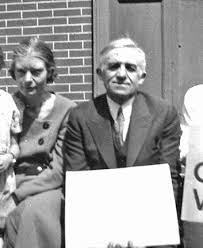
Dorothy Day and Peter Maurin sitting for a group Catholic Worker photo in the early 1940s.
Maurin had a plan for the reconstruction of the then-crumbling American
society. His plan had four planks: (1) houses of hospitality for the immediate
relief of those in need; (2) farming communes to relieve the wretched
unemployment brought about by urban industrialization; (3) round table
discussion “for the clarification of thought” on social issues; and, (4) a
newspaper to get these ideas to the man and woman in the street. Maurin’s
entire plan was aimed at “creating a new society within the shell of the old”
where it would be “easier for men to be good.”
The Birth of a Newspaper
Dorothy Day didn’t immediately comprehend the breadth of Maurin’s
thought, but she jumped at the idea of publishing her own newspaper. She found
out that the Paulist Press—a Catholic publishing outlet—would print 2,500
copies of an eight-page tabloid (originally 9”X12”) for fifty-seven dollars.
Day feverishly began writing articles for the fledgling paper—articles on the
plight of sharecroppers, child labor, the hourly wage for factory workers, and
racial injustice. These, along with Maurin’s “Easy Essays”—short, free-flowing
verse for quick and easy consumption of ideas by the man in the street—made up
the copy for the papers first edition.
Maurin wanted to call the paper The Catholic
Radical, but because of her knowledge of Communist periodicals in the
U.S., Day insisted on calling it The Catholic Worker—a
direct challenge to the then-popular Communist paper The Daily Worker. “Man proposes,
woman disposes,” Maurin jokingly demurred. And so, The Catholic Worker
was born.
They didn’t seek permission from the Church to use the word “Catholic.”
Day wondered about this, but a priest friend of hers wisely advised, “Never ask
permission.”

The enduring Catholic Worker masthead
The first issue of The Catholic Worker was ready
for distribution on May Day—May first, the great Communist holiday celebrating the working
masses—of 1933. In a short column entitled To Our Reader, Day dedicated
the paper:
For those who are
sitting on park benches in the warm spring sunlight.
For those who are
huddling in shelters trying to escape the rain.
For those who are
walking the streets in the all but futile search for work.
For those who think
that there is no hope for the future, no recognition of their plight—this little
paper is addressed.
It is printed to
call their attention to the fact that the Catholic Church has a social
program—to let them know that there are men of God who are working not only for
their spiritual, but for their material welfare.
Dorothy Day was determined to make her stand along with others involved
in the workers’ struggle, so in typical in-your-face radical fashion, she along
with three of her Catholic supporters went to hock the paper in Union Square,
where 50,000 workers had gathered for a massive show of support for Communism.
They were scoffed at and they sold few papers, but Day and her friends were
satisfied with their results. The paper had been launched. In addition, Day and
Maurin had embarked on the great pilgrimage that would consume the rest of
their lives.
(To Be Continued)