
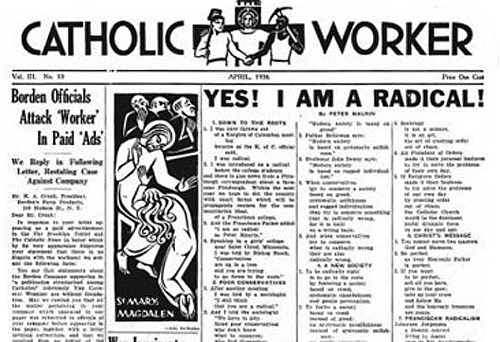
Last week’s “Part I” of my series on Dorothy Day and The
Catholic Worker brought some wonderful responses, including one
from an unexpected source. Lauretta (Sotak) Jenkins messaged me to let me know
that she once was part of a Catholic Worker-type organization called The Young
Christian Students—a group out of Chicago that fostered youth involvement in
social justice issues in the 1940s, ‘50s, and ‘60s. It was through YCS that in
the early 1960s Lauretta would meet a number of SNCC (Student Nonviolent
Coordinating Committee) activists and later marry one of them, Timothy Jenkins—then
an important SNCC presence in Mississippi and vice-president of the National
Student Association. [I met Tim and Lauretta through my involvement with the
non-profit social justice organization Teaching for Change.]
This week, Lauretta and I spoke and she directed me to a brilliant
article by Professor Paul T. Murray, emeritus professor of sociology at Sienna
College in Loudonville, New York. His article, “‘We belong in the wider world’:
The Young Christian Students and the Civil Rights Movement”, appeared in the Winter
2017 edition of U.S. Catholic Historian, which, at Murray’s suggestion,
was dedicated to Catholic involvement in racial justice issues. It’s a VERY
small world. Dr. Murray was the first academic to give my book We
Shall Not Be Moved a five-star review on Amazon in 2013.
Now, here’s Part II of my American University School of Communications writing assignment on The
Catholic Worker newspaper:
Part II of “The Catholic Worker: The Voice of American Catholic Radicalism
Humble Beginnings
The paper sold for a penny a copy; there was no advertising. After
Union Square, Day mailed the paper out to editors of Catholic papers and
periodicals all over the country and to prominent American Catholics. She
explained the paper’s predicament this way:
It is not as yet
known whether it will be a monthly, a fortnightly or a weekly. It all depends
on the funds collected for the printing and distribution. Those who can
subscribe, and those who can donate, are asked to do so.
This first number
of The Catholic Worker was planned, written and edited in the
kitchen of a tenement on Fifteenth Street, on subway platforms, on the “L,”
[and on] the ferry. There is no editorial office, no overhead in the way of
telephone or electricity, no salaries paid.The money for the
printing of the first issue was raised by begging small contributions from
friends. A colored priest in Newark sent us ten dollars and the prayers of his
congregation. A colored sister in New Jersey, garbed in holy poverty, sent us a
dollar. Another kindly and generous friend sent twenty-five. The rest of it the
editors squeezed out of their own earnings, and at that they were using money
necessary to pay the milk bills, gas bills, electric light bills.By accepting
delay the utilities did not know that they were furthering the cause of social
justice. They were for the time being, unwitting cooperators.Next month
someone may donate us an office. Who knows?
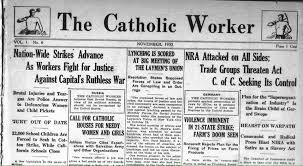
A sample Catholic Worker newspaper from the early days
Success!
After a few weeks, encouraging letters and contributions began to
filter in; a second issue was assured. The editors settled into a monthly
routine for publishing the paper and volunteers trickled in to help with the
work of writing, producing, and distributing it. They found more space for
offices and were somehow able to keep most of the bills paid.
Each issue of the
paper brought new stories of Depression hardships, labor concerns, and the
Church’s attitude on social justice issues. Articles were often written in a
personal style that related both the facts and the author’s impressions of the
event or issue under scrutiny. Day started her own column, “Day by Day,” in
which she gave her own spiritually sharp analysis of current events. Letters
from clergy and readers were printed, as were reviews of current books on
economic, social, and spiritual subjects. Peter Maurin’s “Easy Essays”
continued to be featured. Withing six months, the paper’s circulation had
jumped from 2,500 to 25,000. By May 1, 1935, the paper’s second birthday,
110,000 copies of The Catholic Worker were being
printed and distributed monthly. The paper was an overwhelming success!
Maurin’s Vision
The philosophy of the paper—and the movement that was quickly beginning
to sprout—is a difficult one to encapsulize. Peter Maurin explained The
Catholic Worker’s stance in
one of his “Easy Essays:”
What the Catholic Worker Believes
The Catholic Worker believes
In the gentle personalism
Of traditional Catholicism.
The Catholic Worker believes
In the personal obligation
of looking after
the needs of our brother.
The Catholic Worker believes
In the daily practice
of the Works of Mercy.
The Catholic Worker believes
In Houses of Hospitality
For the immediate relief
Of those who are in need.
The Catholic Worker believes
In the establishment
of Farming Communities
where each one works
according to his ability
and gets
according to his need.
The Catholic Worker believes
In creating a new society
within the shell of the old.
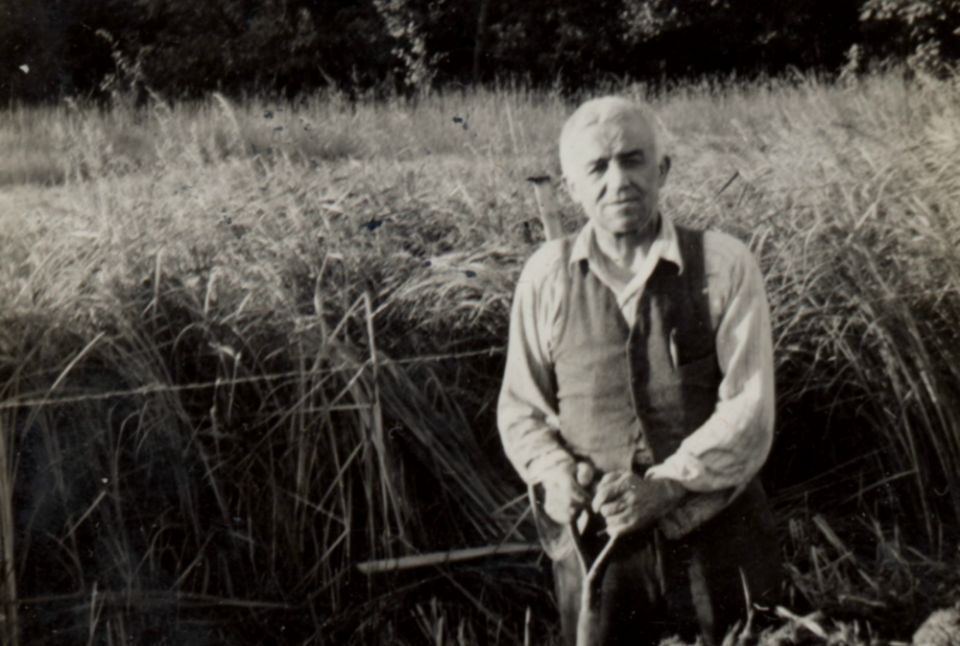
Peter Marin, the inspirational co-creator of the Catholic Worker Movement, pictured here on a CW farm in 1941
“Creating a new society within the shell of the old,” a phrase borrowed
from the Communist-led International Workers of the World (the IWW—or the
Wobblies, as they were known), was the kernel of Maurin’s vision. He called
himself a Christian Communist, and he stood in opposition to the two operative
economic systems of the day—dictatorial Marxism and finance Capitalism. Doroth
Day shared Maurin’s vision. She defined Christian Communism as “worker
ownership of the means of production and distribution, as distinguished from
nationalization.”
Both Maurin and Day envisioned a society of decentralized
cooperatives where a distinct employer class would be eliminated, and where
widespread ownership of property by all men would be a stepping stone to a
Communism in accord with Christian teachings. One might also label their
position as Christian anarchism. It meant radical decentralization of government
and industry.
The Catholic Worker was opposed to the bourgeois mentality of
Capitalism that left out the poor and those not equipped for “survival” in the
get-what-you-can world of American economic Darwinism.
The Worker believed
that each person in need was an “ambassador of God.” They treated the poor as
if each was another Christ, in accordance with Christ’s own words: “What you do
to the least of my brothers, you do to Me.”
Hospitality
The daily practice of the Works of Mercy—feeding the hungry, sheltering
the homeless, clothing the naked, instructing the ignorant—became the backbone
of The Catholic Worker Movement. Workers practiced voluntary poverty, giving
all they had to the poor and serving in every way they could the forgotten and
rejected of this world.
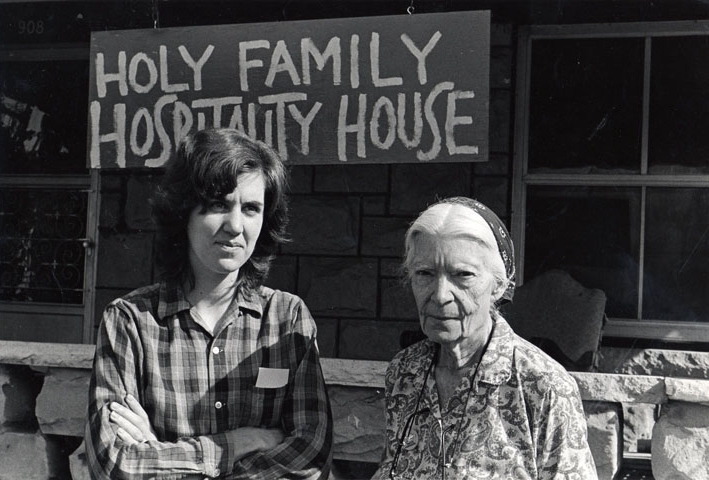
Not long after the
first issues of the paper were on the streets, people began to come to the
Catholic Worker offices for food and clothing. The poor—and there were many
during the Depression years—believed that The Catholic Worker
editors were sincere; they came to share in the hospitality about which they
had read. At first, only a few came. Whatever the need, the Workers tried to
provide it from their own belongings. If a person needed a coat, Workers would
search their own closet for an extra one. If someone was hungry or cold, he was
invited in to the offices for a cup of coffee and a sandwich. Word spread of The
Catholic Worker’s generosity. Soon hundreds, then thousands were
coming daily for food and clothing. The Worker’s only recourse was to beg their
readers for help.
The first appeal for
clothing in October of 1933 read:
Shoes
Needed
One of our friends brought in some men’s shirts and two pairs of shoes, all of which were immediately given to other friends who were in need. We ask any of our readers who have winter coats or men’s or women’s shoes to send them in to the office. Men’s shoes are more necessary than anything else.
Almost every month that followed, especially during the Depression
years, the paper carried more appeals for clothing and for money to carry on
the work of feeding the poor and publishing the paper. Eventually, enough food,
money, and clothing came in that an appeal was necessary only twice a year—once
in the Fall and once in the Spring.
Ask and You Shall Receive
For almost fifty years The Catholic Worker has
existed on appeals. Its business policy has always been to rely on God for
whatever expenses they incur. The saints come in handy, too, when bills begin
to mount up. The Workers’ food bills alone have gone as high as $6,000.
Whenever a money crisis looms, Workers hound heaven for a solution. Invariably
a reader will call with a large donation or enough small contributions will
trickle in to meet the need.
The Catholic Worker has never carried advertising, nor has it ever
accepted subsidies from either Church or State. They beg for every penny they
get. Day explained it this way:
No one asked us to do this work. The mayor of the city did not come along and ask us to run a bread line or a hospice to supplement the municipal lodging house. Nor did the Bishop or Cardinal ask that we help out the Catholic Charities in their endeavor to help the poor. No one asked us to start an agency or an institution
of any kind. On our responsibility, because we are our brother’s keeper, because of a sense of personal responsibility, we began to try to see Christ in each one that came to us. If a man was hungry, there was always something in the icebox. If he needed a bed—and we were crowded—there was always a quarter around to buy a bed on the Bowery. If he needed clothes, there were our friends
to be appealed to, after we had taken the extra coat out of the closet first, of course. It might be someone else’s coat, but that was alright too.
Any subsidy, Catholic Workers believe, would hinder their editorial
freedom. And free they need to be to take the radical stands they have
taken—and continue to take.
(To Be Continued)
Part I of this series can be found at: https://blog.notbemoved.com/post/615785179039039488/dorothy-day-and-her-hope-filled-revolution-of-the