
W. F. (Bill) Minor, legendary civil rights journalist and investigative reporter died this week at the age of 94. Once called “The Conscience of Mississippi,” Minor used his observant, objective, ethical world view to shine a spotlight on the many injustices he witnessed in an attempt to prod his adopted state to become a more just, equitable, and humane place.
The first time I met Bill Minor was at his home in Jackson in November 1996. I was a shy, untested wannabe writer who had an idea for a civil rights book; he was a veteran reporter, having covered every significant civil rights event in Mississippi during the 1950s and 1960s, from the Emmett Till trial to Medgar Evers assassination and beyond. Needless to say, I was nervous. Bill, on the other hand, was warm and welcoming. He invited me into his spotless, well-appointed home and we sat in his sunlit living room and talked for an hour. I was spellbound.
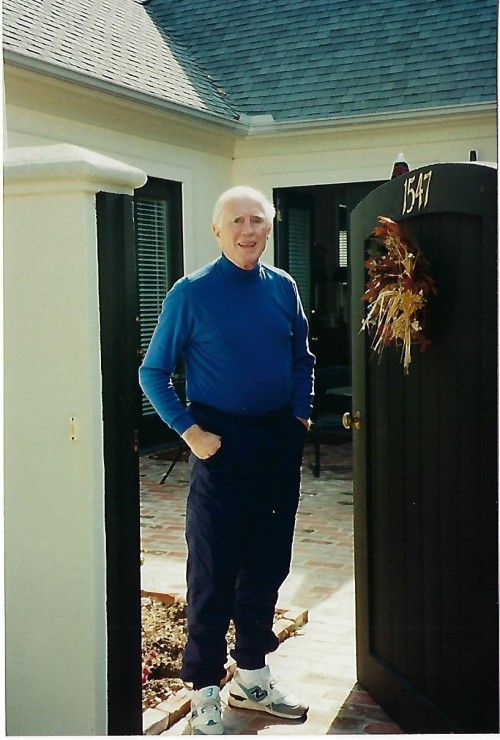
Bill Minor at his home in Jackson, Fall 1996.
I didn’t realize his reputation when I called him just the day before to see if he’d have time to do an interview. He was accommodating. By then, he had lots of time. He was no longer the on-the-beat Mississippi reporter for the New Orleans Times-Picayune (Bill was a native of Louisiana) and a stringer for such national outlets as the New York Times, the Washington Post, and Newsweek magazine. Those days were long gone. He still wrote a weekly syndicated column about Mississippi politics, “Eyes on Mississippi,” which he dutifully and got to his editors (as he would until this past November, at age 94!). And he had had a stroke a few years before so he had slowed down a bit
and his speech was somewhat slurred, but his mind was sharp and his memories
clear.
By contacting Bill, I was hoping to find an objective witness to the events of May 28, 1963, someone who had been on the scene at the Jackson Woolworth’s sit-in—the subject of my proposed book. Fred Blackwell, the photographer who took the now-famous sit-in photo, told me Bill had been on hand throughout the entire three-hour ordeal and that I should call him. That’s how I ended up fumbling with my tape recorder, trying to find an electric outlet while chatting up this legend of the Mississippi press corps.
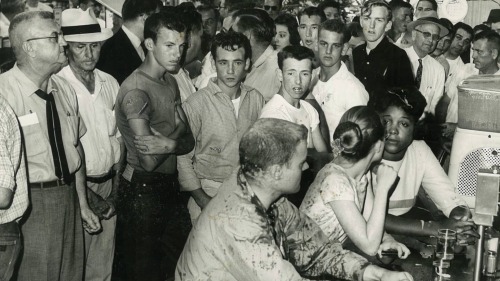
Minor was on hand during the entire sit-in. He is likely the obscured man in the black hat in the upper right hand corner.
I needn’t have worried. Bill was full of stories and loved nothing more than telling them to a receptive audience. His descriptions were fine and detailed. He had a reporter’s eyes and ears and he knew which facts would have the most empathetic impact on readers. The story from our first encounter that stands out in my mind is the one that had a double impact. For two weeks after the now-famous Jackson sit-in took place, the city erupted into a wave of non-violent protest against the existing white supremacist rule. Minor covered the demonstrations daily and wrote extraordinary reports that
guided my research.
Then Medgar Evers was assassinated. Minor was stunned. The next day he went to Medgar’s NAACP office to cover a march that activist and Evers protégé John Salter had planned. Salter was watching the march from the porch of a black homeowner when police spotted him and dragged him off the porch and into the yard. There they began beating him mercilessly with billy clubs, one of which was directed squarely at his head. “A cop hit him so hard, it sounded like Joe DiMaggio knocking a home run out of the ballpark,” Minor told me. The image connects immediately. And every time I tell it to audiences, they wince. Everyone knows that sound and can only imagine what it must have felt like. Minor witnessed it and would tell it often, sometimes substituting the slugger Mickey Mantle for DiMaggio.
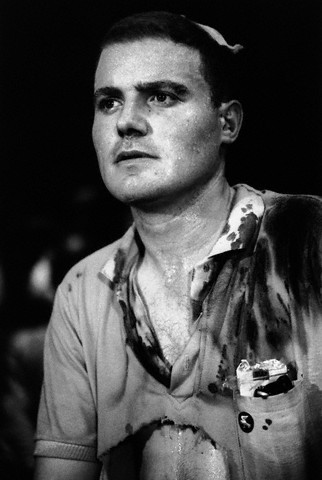
John Salter after the brutal police beating in Jackson after the Medgar Evers assassination. Minor retreated to a church to pray for his city after witnessing the attack.
He also was not shy about showing his own emotions by telling me what happened next. “It would tear me up something awful,” he said of having to witness violence against peaceful demonstrators. “The day Salter was walloped,” he said, “it upset me so much that before I could go back to the
Capitol (where out-of-town reporters had a press room) to write my story, I went to a Catholic church downtown. It just tore at my soul so much that I just … that was the only thing I could think of to do.”
Reports of Minor’s passing have appeared in all of the major news outlets, including The New York Times and The Washington Post and PBS NewsHour. He was a journalists’ journalist. Largely unknown and unsung outside of his beat state of Mississippi (Minor was born and reared in Louisiana, thus his allegiance to the Times-Picayune), all of the major civil rights reporters knew him and sought his insights and advice over the years. No less than David Halberstam called him “a hero to other men who are heroes themselves.”
It was only six months after our first meeting that I would encounter Bill Minor again, this time on my own turf in Washington, DC. He was being honored by many of those same journalists he had helped during the civil rights period at a swanky luncheon at the Mayflower Hotel. I read about it in a profile of Minor the weekend before and wrangled tickets for myself and Joan Trumpauer Mulholland, one of the heroes of the Jackson Woolworth’s sit-in who lived (and still lives) in Arlington, just across the river. This story goes to the heart of Minor’s character, his self deprecation, his willingness to share
the spotlight.
The occasion of the luncheon was the awarding of the first-ever John Chancellor Award for Excellence in Journalism, sponsored by the Annenberg Public Policy Center of the University of Pennsylvania. (The award has since been subsumed into the Columbia University School of Journalism. The honor was posthumously awarded to PBS NewsHour moderator Gwen Ifill just last month.) Minor was bowled over when he was told he had been nominated and selected for
the award, which at the time was accompanied by a $25,000 check. “It was something totally incredible to me,” he said at the time, “that they would reach down here in the boondocks… . “It overwhelms me, frankly. I just never expected to received something like this in my lifetime.”
Joan and I managed to greet Bill as he entered the great ballroom where the luncheon was being held. Such luminaries as Halberstam, Jack Nelson (L.A. Times) and Karl Fleming were waiting to escort him to the stage. But Minor stopped as if in shock when Joan told him that the last time she had seen him was at the Woolworth’s in 1963—she on the receiving end of a canister of sugar and he down in the corner scribbling his notes for his next big story. It took a minute to register, then tears welled up in his eyes. He was overcome. No one else seemed to understand his emotion at the time, but after the long lunch and the longer speeches, Minor got up to accept his award and deliver his prepared remarks. But instead of reading from his script, he deviated from his text to tell the crowd just who he had encountered on his way into the hall.
“I know that most of you here are honoring me today because you think I’m some kind of hero,” he started. “But you don’t know what courage is. I was simply doing my job all those years, reporting on the killings and the beatings and the demonstrations. We have here today a woman who puts us all to shame. Pointing past Ethel Kennedy, who was in attendance, and directly at Joan, he said. “That little lady endured the hatred and vile of the mob for three hours at the Woolworth’s store in downtown Jackson in 1963. I will never forget it. And she came to honor me here today.” Then his voice choked with emotion as he continued to point her out to the crowd.
Though she was camera shy, I gently encouraged Joan to stand and be recognized (since the guest of honor was pointing her out!). The crowd applauded as Bill recovered his composure and continued with his prepared remarks, deeply touched by the award and all the adulation he was receiving. When the program ended, a number of the nationally known journalists swarmed Joan to hear more about her story. (Fleming had also covered the Jackson sit-in, so he was particularly interested in meeting her, as was Halberstam.) It was the first time that Joan’s story began to be widely known. Bill Minor had helped Joan emerge onto the national stage and launch her public career.
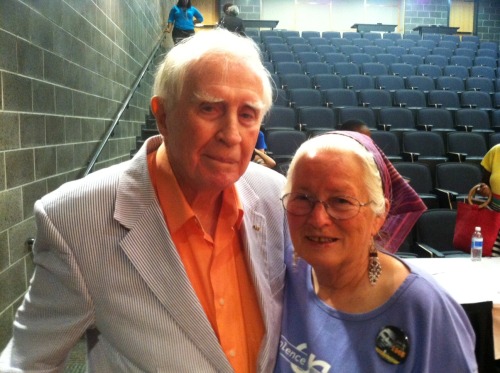
Bill Minor with Joan Trumpauer Mulholland at Tougaloo College for the 50th anniversary of the Jackson Woolworth’s Sit-In.
The next time we saw the conscientious journalist was at the 50th Anniversary Commemoration of the Jackson Woolworth’s Sit-In. Bill didn’t make it down to the outdoor event on the site of what was once the downtown Woolworth’s store—he was in a wheel chair by then—but he did make it to the luncheon held out at the Tougaloo College campus from which the sit-in had been launched. Gracious as ever, Bill was happy to be part of the festivities and thrilled, frankly, to still be alive to witness all of the changes that had occurred since that fateful day in May 1963. I was honored to be able to provide him with a copy of my just-published book, which he later raved about. He was never one to keep all of the glory for himself. There was enough to go
around.
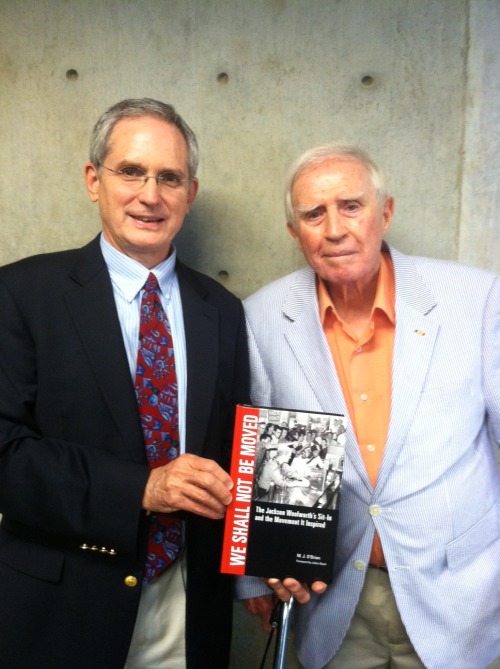
Bill accepting a copy of We Shall Not Be Moved.
My final touchpoint with Bill was back at his home in November 2014. I was starting a new project, attempting to tell the story of the very first student demonstration in Mississippi, the Tougaloo Nine Library Sit-In. Of course, Bill had been there to cover it, two years before the Woolworth’s
sit-in put Joan on the map. And he generously ushered me back into his study this time, the holy of holies, and regaled me of stories of the many people he covered throughout his seventy year career in journalism—from Theodore Bilbo to Robert Kennedy. I’m not sure I got much out of him about the Library sit-in—I still have to transcribe that interview—but I will never forget sitting in his inner sanctum and soaking up the history that was all around me.
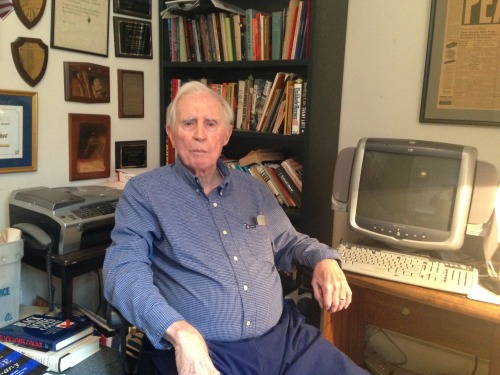
Bill Minor in his home office, surrounded by memorabilia from a lifetime of reporting on Mississippi politics.
Somehow I knew that would be our last meeting. He was frail and needed assistance getting back and forth between rooms by this point. I lingered longer than I should have, until his wife Gloria called him to come to supper. As I was getting ready to go, he went to his closet and pulled out a
photograph from half a century ago—he knew just where it was. I looked at it with astonishment. There he was, Bill Minor, horsing around with then-Governor Ross Barnett at the Centenary Celebration of Mississippi’s secession from the Union. (Yes, they celebrated that in Mississippi!) As this occurred the day AFTER the Library sit-in, this was relelvant to my research, so I asked him if
I could use it in the new book. “Of course,” he said. “That’s why I’m showing it to you!” Generous to the very end.
Joan was the one who informed me that Bill Minor had died last Tuesday. In a very simple e-mail message, subject line “Bill Minor,” she said: “He died early today. RIP, my hero.”
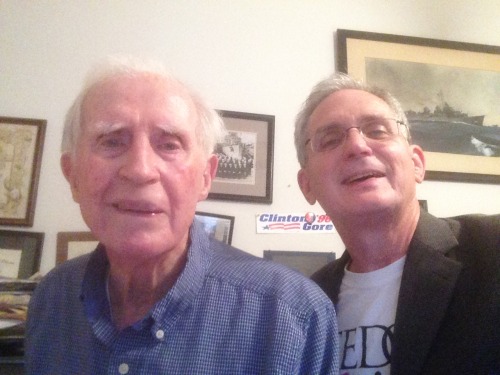
Bill and Mike at their last meeting in November 2014 at Bill’s home in Jackson, Mississippi.